Showing posts with label globalization. Show all posts

Thursday, May 31, 2018

On Other Dystopias

It seems like every day I get on the subway, or go to the movies, I see a promo for some new dystopian film. And what, really, could be duller at this point. The plucky band of teenage heroes, the cruel overlord, the pleas to human freedom that every political group from far left to far right will find sympathy in.

This isn't to denigrate the “dystopia” as an artistic trope. It has its place – in some fine novels, Cormac McCarthy's The Road, Paul Auster's In the Country of Last Things, and in some fine films, Brazil, Blade Runner, The Matrix, Mad Max: Fury Road and the like. But it has gotten so overplayed, so transformed into the most banal of cultural artifacts that the mere mention of a dystopia automatically triggers my bullshit radar. Compare David Mitchell's novel Cloud Atlas – a monumental story of the invisible threads running through history – to the godawful film version by the Wachowskis, which feels like it was written by a 15 year old that just discovered Buddhism.

Of course, the notion of the dystopia, particularly in its cyberpunk forms, has been an essential component of literary and cultural theory since its 1980s heyday, especially in how these cyberpunk fictions reflect themselves in our reality, often to the point of absurdity – Giorgio Agamben's claim in Homo Sacer that modern life was indistinguishable from Auschwitz is perhaps the most offensively bourgeois notion I could imagine, and pretty much anything written by Jean Baudrillard comes off as borderline parody today. Sure, we don't have flying cars or AI romantic partners, but in other respects – Snowden, Bezos, facial recognition software – we are living in a world that would be familiar to Philip K. Dick or William Gibson.


By the 1990s, with books like Mike Davis' City of Quartz or Edward Soja's magisterial Postmetropolis, Los Angeles was being called the postmodern, cyberpunk city par excellence – after all, this is the city whose economic fortunes are inextricably entwined with the image industry, a city without center that arose in the high-capitalist age, and the place where Rick Deckard and Roy Batty had their final showdown in the rain.

But recently, attentions have turned more towards East Asia, perhaps best articulated by Ian Buruma in his essay “AsiaWorld.” Particularly, the monster cities of China, for which the prototype is Shenzhen (population, 1980: 30,000, population, 2017: 12.5 million, well-known as the place where all your shit comes from).

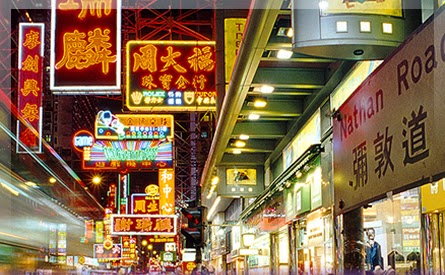
And it's hard not to accept this notion – walk down Nathan Road in Kowloon on a rainy night, and tell me you don't feel like chasing a replicant or two – but I question the singularity of this vision. When I look at the great cities of East Asia, while I do see a pattern, even if it takes on myriad forms, all of them distinct, all still shaped by their own localities.

The first thing you might think of is the cartoon-scape of Tokyo, especially as it is in movies like Akira and Enter the Void. This is the world of postmodernity at its shiniest and most superficial level, the geospatial equivalent of cotton candy. This is a city of English text overlaid on ancient katakana and hiragana, themselves overlaid on even more ancient kanji, a snow crash of signifiers, bright neon signs, oddball fragments of traditional East Asian architecture, sex for sale, particularly in its most commodified and fetishistic form.


Or you could draw your attentions to Hong Kong, the interzone that is neither Chinese nor Western, postcolonial but not national, with its looming high rises (more than three times as many buildings over 100 meters tall as New York), its migrant workers living in warren-like housing on the Kowloon side and in the New Territories, its role as a vital artery in the system of global finance and banking, and in the dingy hallways of Chungking Mansions, where backpacker guesthouses, bootleg watches, and its Nepali and Nigerian vendors hustling every manner of goods you could imagine.

 
For a darker perspective, you could look at Phnom Penh, a city of wage slaves working to produce the goods that even China wants to outsource, still suffering under the collective post-traumatic stress disorder in the wake of the Khmer Rouge, with its capitalists completely indistinguishable from its politicians, its firm-handed authoritarian rule firmly in the hand of global capital and its local compradors, its cheap hookers, its armies of begging gangs and ragpickers.


But perhaps it is Singapore that most reflects the cinematic vision, at least, of the cyberpunk city. It is the place that no less an authority than William Gibson called “Disneyland with the death penalty, ” and it should be remembered that Germany's current chief philosophe and noted mustachioed crank Peter Sloterdijk said that if statues of any political leader of our time will be put up, it will be Lee Kuan Yew. The reportage of the marriage of Confucian and Victorian rigidity is nothing new – people have been doing it for 30 years – but as authoritarian capitalism seems to spread over the world like a dark pall, it seems like too many of us in the rest of the developed world have accepted the Singaporean worldview part and parcel. The prioritization of the image of the city over the content, the embrace of the security state, the reduction of politics to ritual, the reliance on massive pools of cheap labor while keeping that cheap labor invisible and damn near stateless, its superficial claims to the multicultural masking a profoundly regressive racial dynamic. 

 
Tokyo, Hong Kong, Phnom Penh, and Singapore, each of them expressing different modalities of the global city as it occurs in the early years of the 21st Century. And yet two of these – Tokyo and Hong Kong – are cities I utterly adore, despite some of the underlying horror. Repeat for Bangkok, Seoul, Fukuoka, Penang. It reminds me of that beautiful bit from Baudelaire's Paris Spleen:

“In the evening, a bit tired, we wanted to sit down in front of a new café that formed the corner of a new boulevard, still strewn with debris and already gloriously displaying its unfinished splendors. The café was sparkling. The gaslight itself sent forth all the ardor of a debut and lit with all its force walls blinding in their whiteness, dazzling sheets of mirrors, the gold of the rods and cornices, chubby-cheeked page-boys being dragged by dogs on leashes, laughing ladies with falcons perched on their wrist, nymphs and goddesses carrying on their heads fruits, pies, and poultry, Hebes and Ganymedes presenting in out-stretched arms little amphoras filled with Bavarian cream or bi-colored obelisks of ice cream – all of history and all of mythology at the service of gluttony.”

So, as in Baudelaire's Paris, I take the position of the flaneur, the wanderer, making some attempt to process what I see, to correlate.

Which brings me around to film representations. What could be duller and more simplistic than the current cinematic representation of grim futures. What does it say about us that we would rather consume fictional dystopias, and express ourselves vicariously through fictional revolutionaries than actually taking any kind of stance in a moment of rising authoritarianism? Or postulating a “rebel” stance by flogging conspiracy theories, faux-leftist stances that Karl Marx would shake his head at if he were alive today, or any of the many moronic flavors of adolescent edginess on social media. Or perhaps even more horrifyingly, presuming that the more populist flavors of that said authoritarianism are in some way superior to the more universalized, neoliberal versions, and throwing our lot in with Putin, Erdogan, Trump, Farage, Le Pen, Shinzo Abe, Duterte, or any of the other absolute cocksuckers whose supporters think they're sticking it to the man?

And so instead, I look to the city around me. The Burmese graffiti and the stubbed-out green cheroot at the construction site on the corner tell me far more about the world around us than anything in Hollywood ever could.

Thursday, June 30, 2016

A City in the North

When I was about 10 or 11 years old, I looked in my atlas for a place called the Taymyr Peninsula. I'd been reading about the tribal people of Siberia, and I looked for this place, the homeland of the Nenets and Nganasan people, a vast zone of permafrost on Russia's Arctic coast. some 3000 kilometers northeast of Moscow.

And then in a tiny, Italic font. I saw the word “Norilsk,” indicating a settlement on the edge of the peninsula, the name of an impossibly remote city. I wondered, briefly, what kind of place it was – was it a real city of any size? Or was it just a garrison town, a few hundred soldiers on the edge of the wilderness. Or darker, one of the many islets of the Gulag Archipelago?

I don't think I ever looked it up. I filed the name away in memory, one of the many reference superscripts for which I would never look up the footnote.

And then I saw a set of photographs by Elena Chernyshova, documenting the city of Norilsk.


The city is substantial, a place of 200,000 people. As suspected, the rich mineral resources of the region were once mined by the primarily Ukrainian victims of Stalin's Great Purge of the late 1930s, who also constructed the isolated Norilsk Railway, which shipped the platinum, nickel, and palladium from the Taymyr Peninsula to the port town of Dudinka.

Nowadays, the metals are privately managed, by MMC Norilsk Nickel, a Moscow-based company. Its smelters at Norilsk run all day, creating a full 2 percent of the world's carbon dioxide output. The life expectancy is 10 years lower than that of the rest of the Russia, and the soil has become so fouled that it could, ostensibly, be economically viable to mine the topsoil for platinum.


And whether it's due to the city's economic importance, or due to its dishonorable distinction of being Russia's most polluted city, the place is off-limits to foreigners, other than Belarussians, whose own republic, a little reliquary of Soviet nostalgia adjacent to Poland and Lithuania, likewise heavily curtails foreign visits.

This practice remains common in this part of the world. These closed cities have been deemed too valuable to the national interest, in terms of their positions as centers of mines, manufacturing, military operations, or scientific research. There is Zvyozdny Gorodok, where the cosmonauts are trained. There is Snezhnogorsk, the shipyard town on the Arctic shore, near the Finnish border. There is Ozyorsk, the birthplace of weapons-grade plutonium, site of the 1957 Kyshtym nuclear disaster, and home to the radioactive Lake Karachay, the now mostly dry lake filled with concrete to prevent the underlying sediments from shifting, where the radiation levels in the murky water are high enough to provide a lethal dose within an hour.


This sort of environmental-horror photography is a kindred spirit to the ruin porn of Detroit et al that has spawned cult interest on the Internet in the past several years. It's a tradition that I first became aware of in Godfrey Reggio's sometimes intriguing, sometimes cloying 1988 film Powaqqatsi, which opens with men carrying crushing loads of mineral-laden dirt and rock on narrow ladders out of the Dantean pit of the Serra Pelada gold mine in Brazil.


The more modern purveyors of this subject matter primarily focus, likewise, on the grim legacy of attempts at modern industrial revolution, primarily in India, China, and the former Soviet Bloc. There are a few hallmarks. Close-ups of sweaty workers in the teeming mass, blasted scenery, the inevitable human-interest angle of laborers on their break, eating lunch or having a smoke and a laugh.

On the one hand, this brand of photography plays a role as a legitimate form of environmental and social protest, documenting lives and landscapes that would otherwise be near-invisible. What would be distant, solitary, unknowable comes across in intimate detail. 
 
And yet part of me cringes at the focus on the BRIC nations, as if to palliate the guilt of capitalists in the more developed world from their complicity, or to obscure the fact that the end product of all of this en-masse destruction can be found neatly wrapped at your local big-box store, ready for you to drop into your shopping cart.

Norilsk, the city in the North, is in all of us, in our jewelry, in the catalytic converters of our cars. And when I look at the rings on our fingers, in the passing of traffic, I can only a think of a metropolis caked in snow and grime, rusted mining equipment, and long-dead Ukrainians buried in the metal-laced soil.

Monday, April 28, 2014

Alone on the South China Sea

I arrived at Chungking Mansions on a cold, rainy April day, and anyone who's lived or traveled for an extensive period in Asia knows the drill. At every corner stands a skinny Bengali tout in a loud shirt, trying to grab your attention, get you to come to a guesthouse, tailor, moneychanger, or fly-by-night travel agency. The wider the smile, the greater the deception.

            -Hey mister, you looking for something?

I do my best to avoid eye contact, and get into my cramped room as quickly as I can. I drop my bags and try to explore the city. With a limited budget and knowing no one, I walked and walked, until my calves ached, until I just wanted to sit down and watch the boats cross the harbor.

On the one side, it is a city of stone steps tumbling down steep hillsides, narrow and vertiginous streets cutting between tiny restaurants and Chinese herbalist shops where calico cats bask in sunbeams atop pallets of dried cuttlefish and chrysanthemum petals, of mid-century apartment blocks in white brick and sea-green tile with old British colonial street signs in an elegant modernist font, of storybook trams and ferries and schoolchildren with bright red umbrellas, of the warm smells of Taoist temple incense in chilly weather and goose fat pressed into fresh-cooked rice-- a Wes Anderson movie waiting to be made.

On the other, Hong Kong is a banking capital as bland as any other the world over. Its CBD is a tangle of escalators connecting countless antiseptic, high-security structures, with the same piano music, the same black-and-white photos, men with Breitling watches on well-muscled arms and women with Hermès bags dangling from their avian shoulders. I walked through the nightlife sections, and can't find a bar that didn't pulse with vaguely "European" dance music, that wasn't filled with aspiring financial criminals and the braying voices of posh London and Lower Manhattan.

These two Hong Kongs exist parallel to each other, sometimes on the street, often kissing, their eyes closed to each other.

Yet they are bound together by their sheer density, the density of a narrow city wedged between the mountains and the sea. I walked up Nathan Road at night, past rows of old textile factories and towers filled with shoebox apartments, amid an infinite entanglement of glowing Chinese characters.


And on a fine sunny afternoon I took the subway to the north, to where the world's densest human habitation once rose up, a towering slum that is now a park filled with odd chunks of concrete and low-lying tumuli.


I ended my trip atop Victoria Peak, the lush, misty mountain that looms over Central Hong Kong, to see the whole thing at once.

Staring outwards, surrounded by cheery groups of tourists-- Singaporean families, Thai honeymooners, Malaysian retirees. Alone, in my shabby clothes and worn-out sneakers, stubble-faced, without a camera and politely refusing the audio tour, it was impossible not to feel out of place and vaguely suspect.

But what is travel if not dislocation. And this is something people don't talk about very often. And something that becomes all the more salient when you're in a place like Hong Kong, a city with a government predicated on a contradiction, a city that is either self-loathingly Asian or pretentiously Western, either a bastion of democracy in a totalitarian state or the same state's poodle. It is in a place like this, in a situation like this, that the entire world seems to be centered within the field of view of a telescope.

Tuesday, November 13, 2012

The Fate of Mes Aynak

Within a couple of months, in all likelihood, a few pieces of construction equipment will climb a highland track in a remote area to the east of Kabul. They will begin to scratch away at the earth, dislocating stones and drilling deep bores, piercing the vast reserve of sulfide minerals at the heart of the mountain range.

Two thousand years ago, this was an intersection of beliefs, a point on the transit route between the empires of the East and the West. Through these dusty passes came caravans loaded with silk and cinnamon, ultramarine and celadon.

Now it is a remote nowhere on the fringe of human dominion. Above here are the vertiginously high Spin Ghar Mountains. Irrigation systems provide enough snowmelt for agriculture, and, in a province where only a fifth of adults can read or write, the local people's existence relies on what they can extract from a lunar landscape.

Here are the old monasteries of Mes Aynak. As at other archaeological sites the world over, new layers are constantly being found, cities atop cities, a new town always superseding a predecessor. Here were Chinese and Persians and Punjabis and Greeks, Zoroastrians and Shiites and Nestorians, and the countless peoples and faiths that have long been forgotten, their practices unrecorded, their deities beyond memory.


What remains is the Buddhist city, an arrangement of temples and wells and steles. Once, this area was ruled by King Menander, who sat in a throne hall asking the Buddhist sage Nagasena about consciousness and perception. Faithfully adopting the tenets of this new religion, he commissioned the building of stupas with Grecian columns and Corinthian capitals. The Buddha statues of his kingdom possessed the same straight noses and impassive curled lips of the Olympian gods as rendered by Praxiteles.


And as the city fell out of use, it became a simple campsite. Countless armies warred over control of the region, as progressive waves of Mauryas, Parthians, Sassanids, and Mongols marched through, only to be followed later by Brits and Soviets and Americans. It's hard not to think of this area as a cursed place: a lovely mountaintop garden torn apart by the demons of history.

Yet it survived. Unlike the Buddhas of Bamiyan further west, it was never targeted for destruction by the Taliban. Their troops camped here, on the run from the Northern Alliance.

But its destruction is imminent, not because of the old reasons of ideology or religion or feudalism, but for reasons of simple economics in a neoliberal era. With global copper prices quintupling in value over the past decade, and with Afghanistan becoming just stable enough to pillage, the mining companies are moving in, and within six months, the arches and friezes too, will pass into memory.

The mining industry refers to this area as part of the Tethyan Eurasian Mineral Belt, named for the prehistoric ocean that was dried as magma from the mantle of the earth surged to the surface. The ocean, in turn was named for the titaness Tethys, who, in legend gave birth to the rivers of the world. Even the history of a name passes from myth into geology into engineering into business.

There's been some sound and fury in the West about the site's destruction. Online petitions have been drafted, which, as with virtually all Internet-based activism, are exercises in self-congratulation. Global mining syndicates continue their pillage, and the Afghan elites who run the country from their condos in Dubai continue to line their pockets. A Kickstarter fund has been started to fund a documentary film about the site and the project. But that, at the end of the day, will probably be some very lovely footage of a site that will have already ceased to exist-- a rather more intellectual equivalent of a snuff film.

The Anglo-American news media is at pains to point out that the company with the contract to mine the copper reserves at Mes Aynak is, of course, a Chinese company, thereby absolving the profligate consumers in the NATO member states of any guilt.

Every article and every campaign, the above paragraphs included, are alienated experiences predicated on a deeply abstract relationship to the site of Mes Aynak. Somehow we want to identify with these temples will almost certainly never visit. Regardless of all of the entirely good reasons we want to preserve a piece of history-- archaeological knowledge, aesthetic virtue, preservation of the cultural heritage of a third-world nation-- much of our desire is something ineffable. It's that beyond the logic of capital that seems to dictate and delimit our daily life, we still aspire to some difficult virtue that lies just beyond a distant horizon.

Thursday, July 12, 2012

The Far Shore

The other day, I got a ride with a cab driver who spoke a decent amount of English. Her husband, it turned out, was a fellow American.

The story unfolded; they'd been together for over a decade now, and he'd been living visa-free and under the radar for most of that time. "The police, they don't care about what white people do," she told me.

His son, my own age, was living in Thailand as well, teaching without a university degree in a bleak Bangkok suburb, a nightmare zone of industrial estates and boxy white houses and swampy, overgrown abandoned cane fields out beyond Phra Khanong.

In these corners of Asia, squalor can be covered up by superficial respectability. The outcasts, the failures, the desperados of the Western world wash up here. European skin is the mask they can use to conceal their manifold scars.

I've been asking myself a lot lately, as all those who have chosen to live far from their place of origin do, why, exactly I am here. I came here with a vague idea of what I wanted to do, I had my brief honeymoon, and now I have to ask myself a hard question: how long can I stay here now that the briefly flickering candle of novelty has gone out?

Expatriates in Bangkok have a tendency to go through a second adolescence. Liberated from the expectations of their native society, they indulge in whatever vice floats their way, be it sex, alcohol, drugs, or some combination thereof, all readily available at bargain prices. You see them in various states of inebriation, their eyes fixed forward, stumbling down Sukhumvit Road.

They come in all types, but are predominantly men. Some are the stereotypical red-faced lechers. Others are younger sybarites, with close-cropped hair and designer T-shirts. There are the eternal travelers for whom expatriation in a newly industrialized state has become another way to save money. And yet others are the losers running, half-heartedly, from their own responsibilities and failures back in their home countries, faceless and shapeless. I do sometimes meet those farangs who came to Bangkok for highly specific reasons, but for most, they came to Thailand through a strange alchemy of dissatisfaction, fear, lust, alienation, loneliness, curiosity, and international currency exchange rates.

This isn't a new thing. George Orwell was writing about the same scene in Burmese Days. The hateful white people are still here. Merely replace the overgrown maidan and gin-soaked billiard room with a happy hour in Asok. Instead of teak merchants and colonial officers, we have the precise equivalents of Flory and Lackersteen and Veraswami in the era of global capitalism.

I've gotten used to this world: the parties and faux-English pubs; the detritus of empty Sangsom whiskey bottles and crushed up blue packs of L&Ms littering whitewashed balconies; the bitter conversations about life in Thailand; the endless string of men who seem to hate nothing more than the Thai people who stand in the way of their mindless pursuit of the pleasure principle, and their utter contempt for the Siamese nubiles that they persuade to suck their dicks.

We've gone through the massive process of decolonization and globalization, of the fall of old empires, of the incipient rise of new ones. And yet the same brutal, sneering colonial attitude remains.

Which of course begs the question in my own mind, where do I fit into all of this? Is there a better way for one to live on a far shore?

I don't know. I can't know. Lying in bed at night, my mind oscillates between narrative and counter-narrative. It's as if I'm on a perennial trans-Pacific flight, jet-lagged but unwilling to sleep, half-dozing, half-wide awake, vaguely looking at the flickering LED light and listening to the warm hum of the engine, not sure which side of the ocean is Here and which side is There.

So I try to fix my mind on the things that embed me in this place at this time. I step off the train into a rainy dusk near Lumphini Park. The street vendors are grilling strips of meat rubbed with fresh herbs. The lights of the offices are turning off and the lights of the apartments are turning on. A flock of birds flies upward, flies out over the canals, moving in formation towards an unknown point.