Showing posts with label travel. Show all posts

Thursday, July 16, 2026

Quiet Days in Vientiane

For reasons largely beyond my control, I had to fly to Vientiane – not really for work, not really for travel, although kinda sorta for both of those things. I figured it would be good to get out of the city for a bit. My stay would be open-ended, but I booked a cheapish hotel and figured that even if it sucked, I’d be back in Bangkok on the weekend, just in time to see friends, have a nice night out. And I didn’t think it would suck – I’d been to Vientiane a few times before, and remembered it as a sleepy riverside town, someplace that might not be the most exciting, but had the advantage of good local beer, some nice crusty old French restaurants run by sweating Depardieu clones, a few nice little used bookstores – one of the mellower stops on the backpacker trail through Southeast Asia. It didn’t have the spiritual sublimity of Luang Prabang, with its ancient temples and streams of monks with their alms bowls in the morning, nor the party vibe of Vang Viang – the attractions of which, back in my day, were tubing down the river and doing shots of cobra-infused rice wine in the day, and magic mushrooms and DVDs of Friends at night – but it was a nice little small city. 

And if you don’t understand the appeal of a hammer-and-sickle flag flying outside a crumbling French colonial villa as the tropical foliage grows ever thicker, you and I will never truly understand one another.

So I arrived in the evening rain looking forward to the getaway.


I spent the first few days getting to re-know the place. I’d seen the sights – the temples, the Haw Phra Kaew where there’s a sign pointing out where the jade buddha statue known as the Phra Kaew used to be before the Siamese looted it and brought it to Bangkok, where it remains a popular tourist attraction. I had gone to the National History Museum, to see the Lahu fabrics embroidered with images of bombs and helicopters, Buddha statuettes forged from the aluminum of downed American planes, pictures of fenceposts made from casings, the maps of the unspeakable UXO problem, my country’s attempt to annihilate the Ho Chi Minh Trail by ensuring that generations of children in Xiangkhouang Province would risk blowing their legs off on their way to school, the poorly reproduced photographs of jeunes communistes holding up signs saying “Là-bas Monsieur McNamara!” I figured I could just wander and see what was good.

I walked around, I went out. I went to a coffee tasting, as Lao coffees from the Bolaven Plateau are often quite fine. I befriended locals and expats alike, I ate with them and drank grotesque quantities of Beerlao and, if we were feeling fancy, a bit of the delightful Laodi rum, and had some damn good conversations.

The food of Laos remains a bit of a question mark. A walk down the downtown streets of Vientiane reveals far more Thai and Indian and Chinese and Italian and Korean and Vietnamese places and generic burger joints than Lao restaurants. Unfortunate, since the same people, speaking the same language, across the river in the Isan region of Thailand, make some of the best fucking food on earth. At the street stalls, most dishes, indeed, seem to be identical to their Thai versions, pad see iw and rat na and ubiquitous laap seem indistinguishable from what’s available in Thailand. The tam mak hung, their version of papaya salad, seems to be awfully similar to any som tam in Thailand. The jaew are indistinguishable from Thai nam phrik, the only major difference being that they’re still by necessity made by hand rather than industrially. And the backpacker’s favorite, the khao jee pa te, is really just a banh mi. The noodles are called pho and seem indistinguishable from the perfectly OK noodle soups found on streets throughout Southeast Asia.

So what is uniquely Lao? One oft-cited example is or lam, the rich herbal stew flavored with the slightly numbing sakhan vine and thickened with buffalo skin. Unfortunately, it’s a gloopy, under-spiced swamp of a dish. Goy pa, the famed freshwater ceviche, has an unfortunate tendency to be lousy with liver flukes. I took my chances anyway (worth it, yum). I ate mok pa, the fatty fish and fragrant herbs wrapped in banana leaf, and salt-grilled pa yon, an impossibly buttery river fish that I still can’t find an English name for (Thai speakers, it’s ปลายอน in Thai, and I can’t find an English name – Thai Wikipedia refers me to pangasius, and it’s definitely not that). I ate grilled pork udders (chewy) and stewed beef lungs (intensely gamey and metallic), lake weeds and water bugs. The herbs – dill and cilantro and Thai basil and phak phaew and phak khayaeng and even the vile khao thong, or “fish mint” – are beautifully fresh.

And there’s a certain Lao-French restaurant that I was politely told not to tell the world about, where I ate buffalo tartare and crayfish dumplings and drank pastis as the monsoon rain pounded down on the roof. The French clientele gently mocked my silly accent and occasional misgendering of a noun. No air conditioning, Simone Weil books on the shelves, Can and Stereolab and Taeko Ohnuki on the soundsystem – this, too, is a thing of consummate beauty.

But the days went on, and on. Four days turned into a week. And then a week and a half.

I moved from hotel to hotel, each perfectly comfortable and reasonably priced, each feeling immensely temporary. I didn’t even bother to unpack.

As with the food, nothing seems original. The music is either Thai city pop or the standard Asian mix of contemporary K-pop and 2014-era Western pop music, The Chainsmokers and 1989-era Taylor Swift. The products in the stores are all Thai. Even half the shit at the duty free at the airport is Thai. With an adjacent culture with that much purchase and relative wealth, and with a mutually intelligible language, the media is all Thai television and Thai music videos. At the nicer cocktail bars, which varied from awful to perfectly OK, I could understand the highly Thaified Lao of the clientele with perfect clarity. I go to the mall, and the chain restaurants and coffee shops are all Thai. I try to buy clothes, and all the brands seem to be the sort of Chinese and Vietnamese brands you see on Shein that seem English-adjacent but are not English. Wow, a genuine Besor. And is that a real Mouve?

Because it was, after all, an accident of the great game of European colonialism that this country even exists in its present form. The Lao-speaking territories to the south remained vassal states of the Kingdom of Siam, ready to be exploited by Bangkok, while the French chomped away at what they could, resulting in an even more exploited colony that never made a profit, a forgotten landlocked kingdom away in the hills.

And now it feels like time has forgotten the place.

Even the backpackers who passed through seemed to live on a different planet than my peers and I had, and spent their time smoking weed or Beerlao in clannish little small groups or couples rather than effusively making friends with other young and interested and interesting people. Maybe I’m just old.

But the bookstores are gone, of course. As are the crusty old French restaurants… L’Alsace where the elderly owner sneered at me as he poured my Gewurztraminer and plated my choucroute with Alsatian sausages, La Côte d’Azur, where the adorable little Lao girl giggled as she took my order in French… “il veut le ROSÉ!” Barely even the signs remain.

I walked past the site of the old White Rose club, the most notorious nightclub of old Vientiane, when it was a wild town crawling with both American and Soviet spies, French madams still managing the bordelles, past the old Lane Xang Hotel where Hunter S. Thompson frantically typed up his notes for Rolling Stone on the Fall of Saigon, When I first passed this way, the building had still been there, next to the Hotel Douangdeuane… a name which, if we’re being a bit creative, can translate to Astral Weeks…

To lay me down / In silence easy / To be born again / From the far side of the ocean.

In happier days.

Circa 2014.

And as I walk past, a nowadays hooker, a tattoo on her shoulder in this conservative country the only outwardly obvious sign of her profession. She’s wearing a gaudy dress of tiered pink tulle, Vientiane copying Seoul copying Harajuku copying some European princess fantasy. She calls out “hello hansum.” She can’t be having a good time if that’s her agenda at 1 PM on a Sunday.

This really does feel like the end of the world.

I remember when the Mekong came almost all the way up to the Quai Fa Ngoum – it was, after all called the quay. Now, where the Mekong once flowed, wild grasses grow. The dams in China have taken their toll, and let us say kaddish for the pla beuk, the giant catfish threatened by an increasingly low river. I remember when fishwives fanned away the flies from the hunks of yellowing flesh for sale at what were, for Laos, sky-high prices. There’s not much left.

I sit by the river and watch the sunset. The Lamborghini passes, Chinese dark money behind the wheel.

And as I trudge back towards town, I pass the dodgy bar on the ground floor of the abandoned building. The owner tries to summon me in, presumably thinking I looked like I’d be willing to buy some H from them. The evil skulking shirtless tweaker hippies sneer at me. I quickly move on.

And in my darker moments, I think about what Paul Theroux said about the place:

“Laos, a river bank, had been overrun and ransacked; it was one of America’s expensive practical jokes, a motiveless place where nothing was made, everything imported… What was surprising was that it existed at all, and the more I thought of it, the more it seemed like a lower form of life, like the cross-eyed planarian or squishy amoeba, the sort of creature that can’t die even when it is cut to ribbons.”

Deeply unfair, I know, “a lower form of life”… but it resonates on some level, because this is what happens when a country is so thoroughly spit-roasted by the cruel 20th Century, and now here it is. Yet people try to move forward. Chinese mining companies buy billboards informing the public how many schools they’re building and how their open-pit mines are totally not death traps for some of the poorest and most exploitable people in Asia. A new rooftop bar opens, and I’ll be drinking a Negroni there. Protests among the young and conscientious elite of Bangkok mean that new dam probably won’t be built. They start selling the grilled blood sausage with cold beer at the night market. The traffickers of Chongqing park their money in a new hotel project on the edge of town. The music plays in the evening twilight. A child is born, and his life will be 20 times better than his parents, because places like this are the last places where there is hope, real hope.

And I get the email saying my new visa is approved, two weeks later. I book my flight back. Finally.

And yet the river flows on.

Tuesday, April 28, 2026

The Pilgrimage Road

In a general sense, things weren’t going well. Components were falling off the mainframe more rapidly than before. Shit seemed to be going down, in both personal and global terms, and so I did what I normally do. Before the oil prices got truly atrocious, I booked a round-trip ticket to someplace unfamiliar, and decided to spend two weeks amid smoking craters and fragrant citrus orchards, and tried to find some equanimitous sense of things. 

Of Japan’s five most prominent islands, Shikoku is the forgotten one. Neither connected by Shinkansen to the Japanese heartland like Hokkaido and Kyushu, nor a verdant tropical paradise like Okinawa, it exists off to the left side, without major cities. And despite numerous trips, I’d never gotten there, and so clearly it was time.

What did I know? Well, Kafka on the Shore was set there, and I know that young Kafuka Tamura makes sure to eat the udon for which Shikoku is famous, and I know that I don’t much care for udon. And I knew it as being ringed by a pilgrimage road, a sort of Japanese Santiago de Compostela in which 88 temples of historic note around the island were connected. But that was it. I’d barely even heard of the island’s largest cities (Matsuyama, Takamatsu, Tokushima, Kochi). I knew no national parks, no particular loci of the tourist industry. But I had time, and the weather was getting feverish around the Thai New Year, when I used to joke that I always summered abroad.

After a brief stopover in Kyoto mon amour – cherry blossoms over the canals, a few visits to old haunts, a few hisses towards the more uncouth tourists – and it was time to take the Shinkansen west to Okayama, sunny land of peaches and grapes, and then take a local express southwards, crossing the long causeway over the turquoise waters of the Seto Inland Sea.


 There is a pattern that sets in when one travels in Japan. It’s part of a larger pattern – the novel becoming the staid. Upon arrival in the city of Takamatsu, it’s not that different from anywhere else. Japanese provincial cities are hard to distinguish from one another. Little houses, shopping arcades, blaringly loud pachinko parlors, the inevitable foundations of a long-since destroyed castle, and even the local quirks seem standardized. The localized manhole covers simply seem to all be a variation on the same theme.

Maybe I’d made a mistake. Maybe the innate cynicism of the weary traveler – the place changes, but it seems the same – was setting in. And in the case… what the fuck was I doing here?

I liked the rhythm of things, I really did. I find my preferred hangouts, those little institutions of the sort only found in Japan – little café-bars run by solitary men (and the occasional woman), where they can express their curatorial taste in food, drink, music, cinema, and books. I met elegant lady sommeliers, I met grumpy old men who only looked happy when they were perfecting the grind on their Yirgacheffe coffee beans. There are cozy corners. There is tea.

There are the many varieties of citrus that grow on this coast, familiar and unfamiliar. Sure, this is the land of the tangerine and the blood orange and the yuzu, but I came to also know the kanpei and the iyokan, the amakusa and the hyuganatsu.

And every day, I made my way to temple or shrine, temple or shrine, whatever that might be. I climbed up mountain after mountain. Lacking in context, failing to identify the difference between Mahavairocana and Bhaisajyaguru, I simply gawked. I was unable to read the script, and while Google Lens is very good at getting across the meanings of menus at yakitori joints, it is less good at conveying the subtleties of Medieval Shingon Buddhist religious poetry. Again, what the fuck was I doing here?

Natsume Soseki, the father of realist fiction in Japan, lived here for a time as a teacher. He was abjectly miserable, and the only means of coping he found was to relax at Dogo Onsen, a hot spring resort since at least the 6th Century AD. I went there, and it was pretty nice. I had a good soak. I guess he didn’t know what the fuck he was doing there either.

The sign says “Kokoro,” the same as his famous novel. Turns out it’s a hair salon.

I take the ferry to little Naoshima, the best known of the Inland Sea’s “art islands,” the whole turned into a major art installation, save the belching smokestacks of the Mitsubishi smelter at the north end of the island, thoughtfully tucked away lest the crowd of late middle-aged French aesthetes in stylish round glasses actually have to confront the livelihoods of working people. And yet I can’t hate. Because the installations are some of the smartest, most effective pieces of contemporary art I’ve ever seen, absolute masterworks by Lee Ufan, Tadao Ando, and Hiroshi Sugimoto. They pierced the void. Sure there were plenty of works by masturbators like Yves Klein, Jenny Holzer, and David Hockney, but what do I care? I am being given a little contemporary wagashi and a glass of sencha as I look out over the ships beyond Sugimoto’s pristine landscape architecture. Rocks and trees, sea and ships. Here at least, I am happy. Even if the veil is quickly pierced.


Throughout, I ran into a dismal number of loudmouthed American tech bros, i.e. the people I literally moved to Asia to get away from. Many of them were fascinated by my culinary journalism gig, but it quickly became apparent that they viewed visiting top-tier restaurants a bit like unlocking video game achievements. Hungry ghosts in the antique sense, beings of pure consumption that can never be satisfied. To be fair, I encountered a greater number of the lovelier of my countrymen, some of whom may be reading this right now, but a single bad vibe could take me out of my element.  I’m sitting here with an antique cocktail and trying to enjoy the cherry blossoms, and this mustache-and-Carhartt Brooklynite hiding his bald spot under a fitted Knicks cap is coked to the gills and telling me about sick business opportunities.

“This was not the Paris that good Americans went to when they died.” – W. Somerset Maugham, The Razor’s Edge

I often describe my nature as “peregrine.” But this isn’t quite accurate. Because the term peregrine refers to a pilgrim, and I’m not a pilgrim, carefully making my way down the ordained path in search of transcendence. I’m a wanderer.

And yet I followed the pilgrimage road, diligently, even if I was sad and sick and fucked up and my life was thrown into upheaval. I had no idea what I was looking for, but I looked all the same.

At the Ishite-ji, Temple 51 on the pilgrim’s path, in the outskirts of Matsuyama, I arrived despondent. Horrible dreams woke me up early, haunted by ghosts of the present. Again, I didn’t know what the fuck I was doing there, but it found me.

After wandering the grounds, I see a sign. “Pure Cave.”

The sign warns you. No light. No photos.

The corridor is barely big enough for one person. I barely fit, and someone actually fat, it would have been impossible.

It twists and turns in the dark. Steps you have to feel for, walls to guide you, low overhangs that threaten to hit you in the head. You have no choice. You can only feel around in the dark.

And you almost immediately lose any sense of time, of the larger world. You are here in this dark space, and you are trying to negotiate it. It does not yield to you. The only sounds come from you. You are reduced to what you are, mind harnessed to body, alone, confronting an impassive reality.

Until you see the strobing light at the end, and the little statue of Kannon, boddhisatva of mercy.

Her light is fleeting. You crawl back through the dark into the daylight. I have never been so happy to see sunlight.

And I knew I needed to climb the mountain.

I found my way up through the abandoned cemetery, all that citrus rotting on the ground the whole way up, the perfume of the petitgrain blending with the reek of rotting oranges.

At the top, the little donation box amid the little statues is rusted. Whether the corners are curled up in accordance with the dictums of classical Japanese temple architecture or whether that’s just the metal rusting and curling, I cannot say. But I don’t think it matters, does it?

I throw myself onto the gravel and stare up at the tips of the cedars and cypresses, where the forest ends and the sky begins.

I have been here many times. The mountain itself is almost irrelevant. The point is getting here, to this apogee, because I can.

This is what the fuck I’m doing here.

Tuesday, November 25, 2025

Die Vaterland Is Calling Me Back

Any American abroad has probably had this experience. You’re sitting at a bar on some foreign shore, and eventually you disclose where you’re from, if they haven’t figured it out already (and no faking you’re Canadian, that’s pussy shit and you know it). And eventually, they can’t help themselves, but say something along the lines of…

“Ha ha you Americans think cheese comes in cans, ha! Cheez Whiz ha! What you want to shoot your gun at me, Wild Bill Hickok?”

I mean, I enjoy dunking on my own country, and if they’re clever enough and interesting enough to talk to, I’ll join in on the jabs on the States, and make a few regarding their country too. After all, I’ve probably had Cheez Whiz less than five times in my life, so I’m perfectly happy incorporating other nations’ unfair stereotypes into the banter. Friendly ballbusting is one of the best forms of diplomacy.

And while I’ve had this conversation with people of many nations, Germans are by far the worst offenders. When I see the guy in the Birkenstocks with wool socks, I know he’s going to give me a talking to, and he probably won’t be nearly as funny as his Irish or Mexican equivalent.

But then I look around, as I sip my Riesling in a chilly autumn public square in the Bundesrepublik, at the apple cheeked and neckbearded young men in shapeless hoodies, at the icy slender blonde women with ponytails wearing jogging gear, at the jowly and thick-necked and beer-gutted old men in polyester, at the ladies pouring me the excellent wine – one with scraggly hair and eyeliner too thick in a pink fleece jacket, one with hair chopped short and square-framed glasses – all the faces I know from the golf courses and prayer breakfasts and dental offices of Des Moines.

But it’s not just the rubicund phenotype, which of course crossed the Atlantic from greater Germania to my native Middle West.

You have your image of German food, giant sausages and hunks of meat and heaps of potato salad and mash, washed down with great flagons of beer. It’s not at all bad, and can even be very good – but really how much difference is there between that and what you’d get at the average Wisconsin supper club? But just like in Middle America, that’s far less abundant than the takeout places where you can get a pizza or some fast food with origins from migrating brown people (tacos for us, kebabs for them). And whoever talks about the superiority of European groceries has never been to a Rewe supermarket in provincial Germany. At a cozy little tavern, they keep promoting something called “pizza salad.” I am not tempted. In a little town at the foot of the Harz Mountains, I see the fluorescent-lit Chinese place in the Aldi parking lot. There’s a special on orange chicken today.

Or consider the shops I pop into. Granted, the local wine they’re selling is a damn sight better than what you’d get in Ohio, but other than that? Shitty elevator music, kooky little tchotchkes with cutout wooden hearts, doilies with little jars of jam, disgusting fruity home scents. I might as well be at a welcome center on I-90.

Some ladies doth protest too much indeed.

Of course, I came for something more transcendent, and I found traces – I found it in the mist-wreathed schlossen high above the vineyards of the Mosel, where blue slate gravels give us wines of incomparable elegance, or in the spooky old East German transmitter tower emerging through the icy fog high up on the Brocken, from where the witches fly from on Walpurgisnacht, and from where a certain Austrian broadcast his commencement speech for the 1936 Olympic Games, but fuck his teetotaling and vegetarian ways, I had hot coffee enlivened with herbal bitters and a bowl of solyanka to beat back the chill. In the smoke-filled café lined with yellowed movie posters, covered in decades of graffiti, angular men behind the bar, Ian Curtis’ voice warbling through the speakers. In the skeletal industrial wastelands of the Saarland I know from the photography of Bernd and Hilla Becher, in the agonized faces of Albrecht Dürer and Matthias Grünewald, in the scarred heads of Christ and the Four Evangelists in the old basilica built by Emperor Constantine, its adornments ripped out in the Protestant Reformation, its heavy cedar roof destroyed by British bombs, and so all that was left of the old splendor were the chipped and cracked faces of a few old visionary Jews.

So I didn’t feel entirely like I was in Davenport. Entirely.

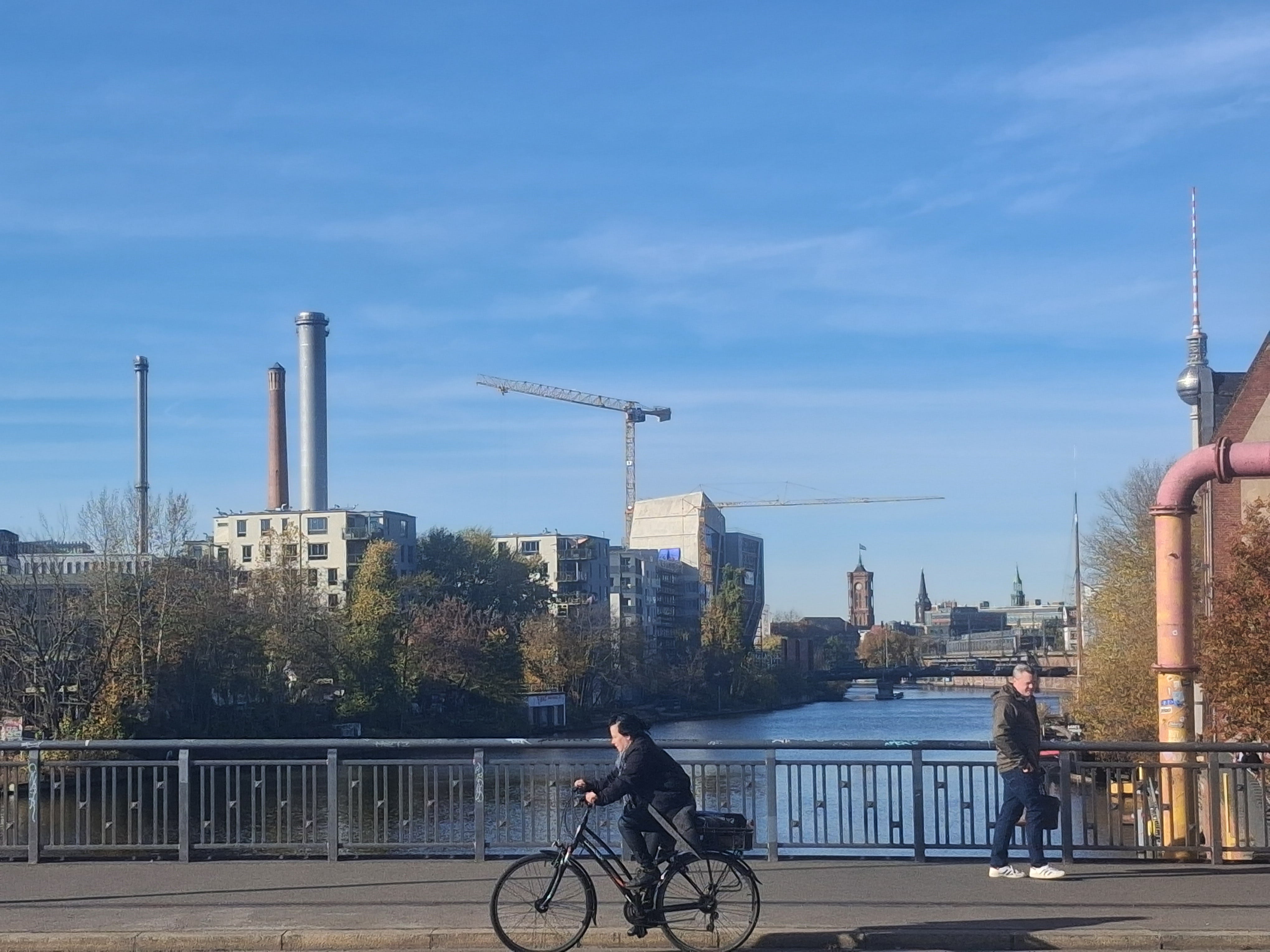
And Berlin, of course, is nothing like Davenport, but this isn’t to say it’s nothing like America, because it’s exactly like Brooklyn.

The hipstery parts of Berlin have remained relatively inexpensive compared to their NYC, SF, and London equivalents. Now, the lingua franca is just as likely to be English as it is to be German, the twitchy Anglos trying to stretch their money fill the streets. Yet there are still enough people who seem to be out doing the thing, some version of that old dream – move to the city, dive into your endeavors with like-minded freaks, hopefully attract the attention of the capital class. Even if many of the forms that now takes look cringe to my aging mind, some possibility still exists, and in that way it’s a bit of a time warp. I asked the bartenders for where to get late night eats, and they had an encyclopedic inventory of open-late immigrant takeout joints, got some kofte, strolled home through the autumn air, and in my morning shower, the perfume of the bar, cigarettes and Nag Champa incense, wafted off my skin and hair… I was 23 all over again.

OK, so it’s not some Berlin of the mind. Sure, I know it’s foolish for me to expect Sally Bowles and the city of stones, David Bowie and Nick Cave lost in the synthesizers and narcotics, commissars in leather coats and skulking dominatrices in leather thigh-highs, but of course I wanted to. But relatively little of those old Berlins remains. Not only because of the carpet air raids of a proud mustachioed Rhodesian who went by the moniker Bomber Harris (“no tears for jerries!”), but also the upheavals of the postwar years, with modernists on both sides of the Wall showing little regard for the past, especially since anything associated with that saber-rattling Prussian kultur was now automatically suspect. This in turn was followed by the giddy boom years after the reunification, so even that modernist optimism towards the future is now passe – the major structures built during the GDR era are torn down without a second thought, and nostalgists have been erecting neoclassical reconstructions of buildings destroyed during the war as if nothing had happened between now and then.

What is there now? Like I said, Brooklyn. There are still a few relics, proud old industrial canals and riverfronts, even if they’re no longer producing motorcycle parts but vegan brownies made with fair-trade chocolate, and there are still the dirty counters on old brick streets where I can get the specialty of the neighborhood (pastrami on rye and a Dr. Brown’s soda for Brooklyn, currywurst and light Berliner weisse beer topped with woodruff syrup for Berlin), there were the cool little galleries, the cocktail bars with skinny intense dudes pouring me a complimentary flight of different evergreen-infused spirits, all of them excellent.

But… along with all the other parts – the 5-over-1 condo buildings with cheeky blinking neon craft beer signs on the ground floor, the urban grit as branding, the largest chunk of the former Berlin Wall, along the River Spree, being dedicated to a bunch of largely really fucking fugly street art for people’s vacay snaps. The café-bar full of tech bros with fashion mullets doing their most horrifying unintentional Lex Fridman impressions. The café-bar full of vacuous talking points on the politics of the Anglosphere, with the coked-out girl castigating me for my moral failings as a yt, ironic given that she was extremely white-passing and far more stylish than me. The café-bar full of wealthy, thin-lipped, and poised xennial Germans in understated luxury apparel who expressed a visceral repulsion at me and looked like they were about to go do rites of Moloch. You tell me I’m in Europe, but I’m seeing fucking tip screens?

My suspicion is that part of what makes Berlin feel like Brooklyn is it has managed to achieve that ultimate dream of Enlightened Brooklyn, to be entirely outside the United States, in an imagined cross-national interzone, at both its best and its worst.

And if I’m going to make this strawman even bigger, the ultimate dream of liberal-minded Germans, it seemed, was to liberate themselves from any notion of complicity with the long shadow of the German past. The response I heard from the very charming, very kind Germans of a liberal cast that I met was that theirs was the land that empowered the WORST GUY EVER, making them by corollary the WORST PEOPLE EVER, as if by self-flagellating sufficiently, the guilt of the past will finally be expiated. Like all forms of self-proclaimed guilt, this is masochism, which is another German specialty, but that’s a tale for a different day. Strike dear mistress and cure his heart.

(see Hans-Georg Moeller on the topic for more and smarter)

And it’s unfortunately an attitude that often translates into self-righteousness. We feel the worst, and therefore we are the best. I have never been told not to do something by strangers more in my life. And we can freely sneer at the less enlightened.

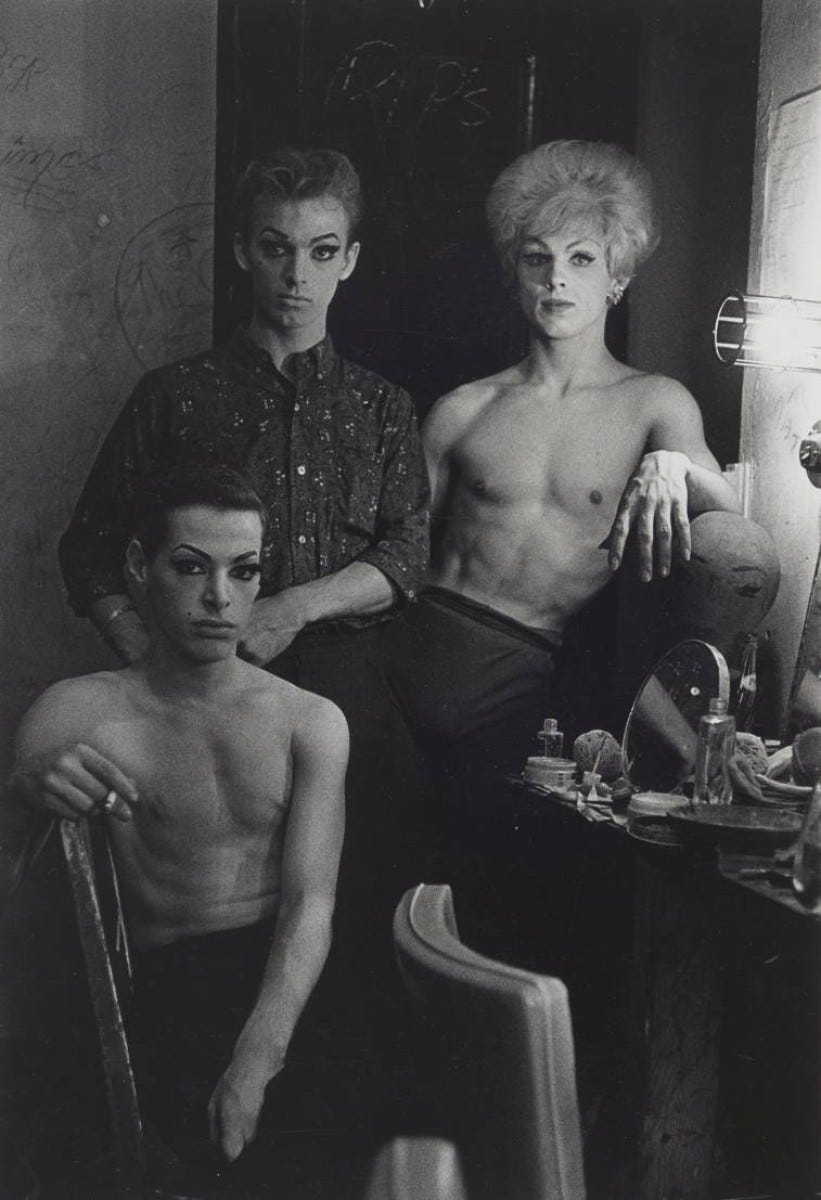
I went to a Diane Arbus exhibition at the Gropius Bau, and Arbus is someone whose work I’ve always adored, but I always felt somewhat uneasy towards. When writers talk about her, they tend to fawn over the dignity and accord she gave to her outsider photographic subjects, but I always felt there to be something lurid about her work. At the exhibition, I looked at the catalog for the photos that really did seem to make their subjects look glamorous, and they were Mia Farrow, Norman Mailer, and various Warhol Superstars. Nudists, drag queens, carnival freaks, and snake handlers and just ordinary, not very attractive, not very poised people seemed almost like fish on display at the market, with the same dead-eyed stares of whole fresh trout on ice, 10 bucks a pound.

And seeing all the impeccably dressed Berliners gawking at the gawking just felt awkward, especially when I gawked back at them.

Arbus, I think, genuinely did want to find the common humanity in her subjects, and the more I learn about her life, she saw her outsiders as kindred spirits, troubled soul that she was. And her empathy is that of someone bearing the same wound, one which maybe we cannot admit we all have. She exposes us to an atavistic form of ourselves, stripped away, rendered vulnerable in all our odd thoughts, flabby, marked, disabled, re-gendered, somehow violated.

But were the gaunt faces of the masterworks of the German Renaissance that I had seen that much different?

And maybe through Arbus’ view of America, they were looking through their chic square glasses at something very familiar.

At the children’s park, the phrase “Sigma Boy,” which I believe is in reference to a TikTok slop content earworm by Russian children, is spraypainted across the slapdash plywood. Lord of the Flies by way of Andrew Tate.

For a long time after the war, the so-called “Rhenish model” did a lot to soften the contradictions of capitalism in West Germany, a social market economy with strong representation of labor in corporate decision-making, and strong bumpers in place to prevent more extreme beliefs on either the right or left, turbocharged by Marshall Plan money. Meanwhile, East Germany, for all its problems, did provide a basic standard of living for its citizens. But since then? The rise of austerity politics in the West, and shock therapy programs in the East – you’re on your own, bucko.

Karl Marx’s childhood home in Trier is now a dollar store.

Which conversely, makes the rise of the AfD, particularly throughout the Eastern regions, a horrifyingly logical likelihood, a black mark that’s increasingly impossible to ignore. Not that their economic position was equitable – they, like all right-populist parties at present, realize they just have to employ proletarian rhetoric without needing any substantive policy behind it. I had thought of them as just another gang of lummoxes, but when their platform includes banning the sale of kosher meat… But whoever their targets may be in 2025, let’s just say I can feel the nights getting a bit more crystalline.

“Ha ha you Americans, you voted for Trump.”

Yeah, well go to Thuringia motherfucker.

And born of rich Amerikaner loam, I only see a series of distorted mirror images. The world is burning. Die vaterland is calling me back. I have a plan…. Mein führer! I can walk!

We’ll meet again…

Thursday, August 7, 2025

In the Middle Kingdom, Part 2: Dragonfly Eyes

In spring of 2024, I was at the Tokyo Museum of Contemporary Art, deep in the heart of the sort of old Tokyo streets that remain sparse and ragged. It’s where I first saw Xu Bing’s Dragonfly Eyes, or at least as much as I could manage in an unplanned visit. I’d later go home and watch the whole thing on Youtube. 

The premise is simple, almost a gimmick. The footage is culled from thousands of hours of CCTV footage from around China to assemble an otherwise fairly anodyne love story. But the plot is only the thin armature that holds it all together. The real joy of seeing it is a voyeuristic look into the lives of what is often regarded as a borderline hermit kingdom, integral to the global circulation of capital, but little-visited and little-known, particularly outside a few major metros – a glimpse of ordinary people at work, at the pharmacy, enjoying the pleasures of ordinary life.


And that’s what I thought of on the taxi in from the airport in Shanghai – my god, there’s a whole normal goddamn country here.

Which to many is going to be the biggest shock, given how much ink is dedicated to the mystery of China – whereas once Occidental writers once wrote about the inscrutable celestial mandarins drowning in the river trying to catch the moon, they now write about smart cities and social credit scores, and the messaging is just as vapid as it was 150 years ago. So there’s an anxiety of influence there that stalks me as I write – I want to distinguish that which is genuinely bizarre and unique about contemporary China, without falling into the lazy cliches that stalk virtually all writing about the country in the Anglosphere. Granted, that experience was of Shanghai, and while the valences differed in the gloomy industrial suburbs and sun-faded steppe towns, the principle was the same. The middle-aged man drinks his after-work beer and smokes his cigarette in the doorway to the apartment block, the teenage girls make little finger-hearts and pose for their selfies, the career woman frets over the texts from her side dude, the boys in soccer jerseys and the girls in pigtails go over their math homework and the clerk in the little corner store looks up from the game on his phone and sees he needs to put more Cokes in the fridge.

But part of the reason I’m starting with the bizarre normalcy of the Chinese streets is not just as a counter to the propagandistic messaging one sees across Western media, but because it is actually a difficult place to access. The visa process is an abject nightmare, time-consuming and onerous, and even the exemptions that are in place are arcane, with contradictory information online and poorly translated websites with jankety interfaces. Beyond that, everything is, naturally, mediated through apps, most of which are either impossible or exceptionally difficult for a foreigner to access. For example, WeChat, a standard platform, requires you to be verified by a WeChat user who has been using the app for 12 months, the Weixin pay platform within the app for 6 months, and has not verified any other first-time users within the past month. I didn’t get to use it. And that isn’t to even mention the fact that one is accessing one’s financial data within the People’s Republic is enough to trigger automatic blocks on your bank account, regardless of how many long-distance phone calls you make begging them to take note and being reminded that “[they] care about your security.” 

Which of course reflects a gatekeeping. The Chinese systems and the everyone-else systems are kept at a deliberate distance, like two species evolving on different sides of a broad river.

So what is on the other side? 

Once you crack the system, once you finally get the hang of it – it’s impossible not to be impressed. Procedures are coordinated, efficient, and inexpensive. You’re effortlessly jumping into prim little electric taxis that smell (nostalgically) of cigarettes and BO, driven by gruff uncles that hack up morning half-pack out the window between historic sites and antique restaurants. Despite what you may hear about gutter oil and plastic rice – jenkem for CNN viewers – I’m happy to report that the spiced lamb skewers were flavorful and the cherries tart and sweet.

The high-speed train system should be enough to blackpill any Westerner – I come from a country that can’t build a pissant metro without having to deal with armies of red-faced suburban homeowners and byzantine public-private partnerships, and it will take decades to build. The system in China, conversely, is consistently clean, efficient, and inexpensive to use, expensive to build, but designed with long-term benefits in mind, and to alleviate the many economic externalities caused by poor infrastructure – the paymasters within the state accept the loss leader, because they view this as an investment, which is a tough thing to imagine when you come from a society run by profiteers who don’t care about much of anything beyond their Q2 returns. And you have to think that maybe, unironically, these are Brautigan’s machines of loving grace. 

It felt a bit like I was walking in the shoes of those early 20th Century European intellectuals, looking at America with awe and horror. I am a representative of the falling world, here in the rising world, and it’s impossible to feel anything other than the sublime, fascination and unfamiliarity and admiration and fear in equal measure.

Yevgeny Zamyatin’s We is often thought of as an anti-communist classic, and to be fair, Zamyatin was no fan of the USSR, despite his past as a Bolshevik revolutionary. But one thing the standard reading forgets is just how enraptured and expressionist Zamyatin’s descriptions are of what we would consider a dystopia. 

“Take, for instance, this. In the morning I was at the dock where the Integral was being built, and suddenly I saw: the lathes; the regulator sphere rotating with closed eyes, utterly oblivious of all; the cranks flashing, swinging left and right; the balance beam proudly swaying at its shoulders; the bit of the slotting machine dancing up and down to unheard music. Suddenly I saw the whole beauty of this grandiose mechanical ballet, flooded with pale blue sunlight. And then to myself: Why is this beautiful? Why is this dance beautiful? Answer: because it is unfree motion, because the whole profound meaning of dance lies precisely in absolute, aesthetic subordination, in ideal unfreedom.”

The dragonfly’s eyes flicker in the distance. 

Objections here are pretty obvious. You’ve heard most of them, with varying levels of reliability – lack of free expression (which is often reframed as a point of pride, an antidote to “disorder”) to social credit (an almost completely ginned up story designed to stoke terror in the heart of the well-meaning Atlantic reader). And to be fair, living in a mass surveillance state fucking sucks, particularly one that well-oiled.

And it comes at you at inopportune moments – when you see the QR code on the apartment door, when you’re stopped and have your notebook rifled through, presumably in search of flyers about Jesus or something of that nature. When you realize that there is a contingency upon which the new China is being built. My delight in flânerie through the streets of Shanghai could be easily contrasted with the merciless checkpoints of Beijing. 

But if you’re reading this you probably know the extent to which you’re already under the microscope, at least to some extent, from both the private and public sectors. Patriot Act, built-in forensics in devices, biometrics, you know all of this already, and it’s best not to think about it, especially given the degree to which we seem to have all collectively given up hope in any kind of an alternative. Organizations like the Electronic Frontier Foundation and the Internet Archive, beautiful in their goals, seem almost as quaint as the Free Tibet concerts and Trotskyist reading groups of another era – quixotic missions for idealists who still, bless them, truly believe another world is possible.

Some asshole dork is probably ready to play the “nice whataboutism” Yu-Gi-Oh card, to which I say, fuck off, I’ll steal your Yu-Gi-Oh cards and trade them for an eighth of mids. I’m making a direct comparison here – the nature of the surveillance might differ, one might choose direct censorship over incentivized and nudged corralling of the human soul (and the direct censorship is to be fair probably worse), but the similarities should be, to any enthusiast for freedom, uncomfortable. 

And at least the Chinese provide treats. Try paying for a hotel or booking public transit stateside. And for a double contrast, compare the China of now with the China of generations past, even after Deng Xiaoping’s market reforms. The Chinese must be the last people on earth who see life getting better and better, rather than a slow miserable death, if for no other reason than that they started from nothing.

I drift back to the West Lake in Hangzhou, where I started, to the old folks with their boiled peanuts and medlars. Had they been urban youths sent down to the country? Or had they been militant Red Guards? Or had they been the countless those in between? 

As for me, as much as I enjoy the peanuts and the medlars, I am still a product of a very different place or time – for the jolly, double-chinned crowd, this is the culmination of a long and hard life, a transcendent epoch of rest. As for me?

I still love cities at night – even if I am slowly aging out of the nightlife demographic – but as someone who was always a bit on the periphery, the being peripheral is no skin off my back. I swan through the streets of the French Concession in Shanghai, surrounded by people much prettier and more stylish than I, and they pay me no heed, as I pay them no heed. I’m happy to walk on this lovely spring night, a soft rain falling. 

I stop in at the posh wine bar, and I am left alone on the rooftop – the better-connected, the ones who know exactly which bottle to select to impress their clients or their attendant crowd of fawning girls draped in Alexander McQueen, they’re inside. I am here with the malfunctioning lights, but I don’t care, their cellar selection reflects the taste of the new China, and I have in front of me a glass of Charmes-Chambertin, and I am left to enjoy it in peace, each subtle aroma sending me to a place and time from my past – here, the smell of the incense in my dorm room, and there, the hippie grocery store in my hometown, and over there, the spice cabinet from my old rattrap apartment back in Seattle, living with two middle-aged gay addicts in an illegal sublet for 600 a month, and I was one of the last to experience that. I come from falling America, and I’m here in rising Asia. And I don’t even care about the rainfall all around me.

Only to walk through the slick streets, a little music playing from the intervening years, until I find myself under a parasol.

Thursday, July 10, 2025

In the Middle Kingdom, Part 1: Wuwei

What lazier way is there to title a book than the “Tao of…” (other, of course than “Zen of…,” with apologies to Mr. Pirsig, he did do it first and best). It’s an easy way to flog a book on some particular or quotidian thing, just bard it with a bit of Eastern mysticism, and an often shockingly superficial understanding of Asian religion, but it’s OK, because most of your reading public will be familiar with these concepts in name only. So off you go, and the “Tao of Fly Fishing” it is. 

(Note to self: check if that’s a real thing lol omg of course it totally is, and maybe the author is a true sage, but let’s just say my suspicions are not assuaged)

So, without going to Wikipedia, what could most of us say about Taoism? 

To be fair to my fellow damaged occidentals, it’s a devilishly difficult system to put your finger on, especially given its longstanding historical associations with esoteric and mystical beliefs despite the lack of mystical language in the Tao Te Ching, especially given the ways in which it has, like all Asian faiths, lent itself to syncretism, and the sheer openness of interpretation of the texts themselves, even by the woo-woo standards of religious literature. It is written in these dense, hermetic little aphorisms, which along with the allegories of the Zhuangzi as well as countless astrological guides, herbals, and alchemical manuals, form the corpus of Taoist holy text.

If I have to compare the whole thing to anything, it would be Robert Burton’s maddening, lengthy The Anatomy of Melancholy, an equally hermetic 1000-page Baroque treatise on the nature of the melancholic, rooted in the theory of the four humors, largely consisting of peculiar cures and musings on ancient Greek thinkers and legends. 

In that openness, I naturally found an appeal. Rather than religion, the Tao seemed more like a poetic, gestalt approach to the world. Even the first line of the Tao Te Ching is a fuck-you. The way which can be walked is not the eternal way. Sorry, next. Instead, we can only hope to listen closely to the music of the spheres, and try not to be idiots or assholes. Let that move me rather than being bogged down trying to make a rational decision in the infinite choices that flaunt themselves like streetwalkers in the grim stage of history in which I find myself. I can only try to move through as gracefully as possible, hoping to take effortless action, or what they call wuwei.

Knowing that there was no “knowledge” there, per se, no ultimate faith, I decided to take a cue from William James, and embrace the will to believe. I didn’t even know what I was believing in, but that was beside the point. I made a conscious decision, and chose to see where it leads me. 

So the wuwei led me to China.

Everyone has a take. The nation of the future. The number one enemy of human freedom. The inscrutable empire. The spearhead of communism. The spearhead of capitalism. The world’s oldest and noblest human civilization. A country irrevocably destroyed. A pillar of strength. A Potemkin village, a whole Temu-ass nation. 

Eh to all of that.

I’d rather smile at the aunties sitting next to me by the West Lake in Hangzhou. They laugh and gossip and enjoy their bags of medlars and their bayberries and their boiled peanuts, and their husbands smoke Chunghwa cigarettes, once a privilege of the Politburo, through stained teeth. They all loudly cackle and hack up phlegm and sip their tea. 

Robert Burton used to watch the boatmen of Oxford screech and swear and spit between writing the Anatomy.

They were men and women of an age where they may well have been sent down to the country. So let there be a blessing upon the sunny terrace and their medlars and cigarettes. They say that there are ten scenes of West Lake, depending on the seasons – the spring dawn on the Su Causeway, the lingering dawn, the autumn moon. This spring afternoon felt more than enough. 

Karl would have loved it. So would Rosa. But that Jiang Qing was a real ass, wasn’t she? Those were quite a few dead sparrows.

Nonetheless, the water still flows under the climbing vines on the old stone bridges of Zhouzhuang. Nonetheless, the stoic warriors still stand in silent formation, holding watch for their emperor beneath the mercury-fouled silt. 

And I can sit in a Shanghainese restaurant dating to the late Qing Dynasty, where the eels are slightly charcoal-grilled before being braised in spices and rock sugar, the chafing dish adding a second layer of char. The pork knuckle is cold and stodgy and dense under aspic, and a sip of hot Pu Erh tea turns it into an incomparably rich soup. A private joke among the last generation of mandarins. Men who would set their teacups on lilypads as they dreamed about butterflies.

“This is a way of showing the small in the large: in an unused corner plant some bamboo, which will quickly grow tall, then plant some luxuriant plum trees in front to screen it. 

This is a way to show the large in the small: the wall of a small garden should be winding and covered with green vines, and large stones decorated with inscriptions can be sent into it. Then one will be able to open a window and, while looking at a stone wall, feel as if one were gazing out across endless precipices.

Here is a way to show the real amidst an illusion: arrange the garden so that when a guest feels he has seen everything he can suddenly take a turn in the path and have a broad new vista open up before him, or open a simple door in a pavilion only to find it leads to an entirely new garden.” – Shen Fu, Six Records of a Floating Life 

I take a taxi through the hutongs midway through demolition in the northern suburbs of Beijing, a little Ethel Cain playing on my headset, to the base of the Back Hill in the Garden of Harmonious Pleasures, on the north edge of the Summer Palace. It’s a steep climb, straight up amid old brick pavilions. These were once full of splendors, but when the Second Opium War and the Boxer Rebellion came, loutish British soldiers marauding through, sacking and stealing, smashing screens, pocketing jewels, grabbing curios which would go on to decorate the bourgeois living rooms of West London.

Because a trip to China is a trip through the horrors of human history. Here, the plaque says, is where caves in the Northwestern loess collapsed en masse in the great earthquake of 1556, burying thousands in their dugout homes. Here, the next plaque says, is where the Song Dynasty intellectuals committed suicide rather than submit to the Yuan. And over here is where the emperor’s mistress was tossed into a well alive. The stone lid they put on it that day is still there. 

In Nanjing, where the crayfish are beautifully sweet, the self-titled rulers of the Taiping Heavenly Kingdom slaughtered the Manchu men first, and the Manchu women second, and then 30 million of their own Han Chinese were killed in the fracas, and 70 years later, the debonair and handsome Prince Yasuhiko Asaka, uncle of the Taisho Emperor sanctioned the industrialized mass murder of 200,000 civilian residents of the same city – and given his royal status, he was granted immunity. He died in 1981, a pious Catholic and wealthy golf course developer, living on my beloved Izu Peninsula coast west of Tokyo.

On the Back Hill, I am exhausted, the midday sun shining bright, amid the scars of old wars. 

But then I reach the pine-crested top, and the trees part and reveal Xanadu.


The mandarins are long gone, and us commoners get to traipse the plaisance along the Kunming Lake below. The girls get to do their hair into elaborate updos and dress up like empresses and concubines and water-sleeved fairies and interwar Shanghai femmes fatales. Along with the occasional anime schoolgirl. 

Not that it’s all lovely – a pox upon the gaggle of fat old ladies in jewel tones who nearly pushed me into the ponds in the Humble Administrator’s Garden in Suzhou while they took a group photo, hideous knockoff sunglasses perched on their porcine faces. Chinese tourists have a reputation for being monstrous abroad, but it turns out that even domestically, all it takes is a selfie stick to turn a kindly aunt into hellspawn. And as I traveled, I had more than a few deeply unpleasant encounters.

Lacking the time to climb the sacred mountain of Huashan, I made my way to the Huaqing Pool, where the love of Emperor Xuanzong and his consort Yang Guifei was not to be, as told in the saga The Song of Everlasting Regret. Where, as the only Westerner, I was surrounded by more gawking locals who didn’t even have the courtesy ask if they could take a picture with me. More jewel tones. More knockoff sunglasses. 

The structures are largely hideous contemporary recreations, complete with plastic lotuses in the pond and mist machines.


“Other people are joyous, like on the feast of the ox,

Like on the way up to the terrace in the spring.

I alone am inert, giving no sign,

Like a newborn baby who has not learned to smile.

I am wearied, as if I lacked a home to go to.”

- Ch. 20, Tao Te Ching


“All my joys besides are folly,

None so sweet as melancholy.”

- Robert Burton in his overture to the Anatomy


But then I saw the path lead up the mountain of Lishan. Surely, this must be the way. 

And I climb to the top, to the little Taoist temple where the monks and nuns smiled and greeted me, merrily attempting to speak to me in Chinese, clucking through missing teeth. I simply smiled back and shrugged. They offered melon and steamed buns. And looking at the statues of the deities, I learned who my Taoist protector god was.

General Zhang Geng was an official of the decadent late Ming Dynasty who defended his family against unjust persecution, who defended the common folk against tyranny and oppression, who devoted his life to what he believed to be the honorable and honest way of doing things. This went as well as it normally does – of course the emperor offed him. And now, so they say, he keeps watch over all those born when the year of the tiger occurs in conjunction with the elemental sign of fire. 

I bought a cinnabar amulet there. I keep it in my messenger bag still.

And as I stared out at the turmeric-colored river, down towards the spot where the Qin Emperor’s mysterious necropolis supposedly lays undisturbed, I knew that I should be there, amid the lilacs and the cedars. 

In the distance lurked concrete towers.

As to those, I’ll see you in part 2.

Thursday, May 1, 2025

The Obliterated Island

They ordered the tunnels to be built underneath a hill, towards the south end of the island, across the river from the little city that had once served as the capital a hundred years before, back when this was an independent kingdom. The admiral noted the quality of the sandstone – fine-grained, easy to quarry, but also remarkably resilient. The locals had a special name for it, in their dialect. They hid in caves hollowed out of the same stone.

It wasn’t much, but it would do in a pinch. The navy, once the terror of the sea, had been pushed back, forced into increasingly desperate action in a bid to keep the enemy away from the homeland. An invasion of the island itself seemed imminent, and they needed someplace safe, in the hope against hope that they might make it through. These men had been told they were going to unite a continent. Now they struggled under the tropical sun, quarrying out sandstone.

When the bombing raids began, the admiral and his men were trapped down there. He sat in the heart of his labyrinth, a simple bed, a simple desk, some radio equipment. Not much. He was did his best to try to convince the men that it was going to be alright, that reinforcements were on their way.

And yet the situation grew worse and worse. Thousands were down here, stranded. As the bombing raids increased, they couldn’t go outside. They slept huddled together, standing up, in the little alcoves in the soft sandstone. They shat in the corners where they could, the reek inescapable. And they waited, even as bomber after bomber flew above, shaking little bits of sandstone gravel from the roofs.

Until the admiral realized it wouldn’t happen. The enemy had already taken the northern half of the island, leaving the few infantry remaining stranded on the hills to the south. He had to make his decision. He pulled out his pistol, unable to salute the rising sun from deep within his underground maze.

Some finally sallied forth, a suicidal charge to the bright light outside, carrying out a dictum under two martial codes – one modern, brought back by the intrepid young men of the previous century who had carried the most contemporary ideas and philosophies of France and Germany and England back to their little nation, one far more ancient, derived from a time when a handful of feudal lords fought over what little arable land they had between their rocky, forested mountains and the endless sea.

And other men stayed in the tunnels. Weeping, desperate, they pulled the pins from their grenades, bodies still crammed in, device after device exploding, as young men who just a few years before had been tending to their fields and delivering letters and teaching in rural schools chose death over capture.

The few survivors out of the thousands who were down there came up to an obliterated island, fields destroyed, towns leveled, nearly every tree felled, many of the residents evacuated some months earlier, but a full 25 percent of the island’s civilians dead – either killed by the enemy, or goaded into suicide by commandants who could not bear the thought of their people living without the guidance of the imperial standard.

I stare out of the tunnel, into the light and emerge onto that high hill above the city, a light rain falling, halfway between Tokyo and Manila.

I knew the American military had been there for years, on the island of hacksaws and jawbones, hell, I’d known guys who had been stationed there in the USMC, but I didn’t know that we had administered the island as late as 1972. We left American-style plugs (two blades, unlike the two rounds used elsewhere), an affection for Spam and “taco rice” (made from the taco meat of scrounged MREs, and as disgusting as it sounds), and an inferior public transportation system.

“Keystone of the Pacific” read the old American license plates still hung up in bars and restaurants around the island.

Now blurred by the scratching processes of history. That mediocre Mel Gibson movie where Andrew Garfield played a real simple feller who just wants to love him some Jesus and save some folks. That’s what about the limit of what most Americans know. That and it’s where Mr. Miyagi is from.

And I had remembered, from news stories in my childhood, the 1995 incident in which three American servicemen, having been put off by the high prices of local hookers, had instead gang-raped and murdered a local girl. And indeed, I remember seeing the press conference where the then-head of the Pacific Command, America’s top military officer in the entire Indo-Pacific region, responded as follows:

“I think it was absolutely stupid… for the price they paid to rent the car, they could have had a girl.” – Adm. Richard C. Macke

Then I stand under the two bishop wood trees, Bischofia javanica, that had survived the bombardment of the Shuri Castle, on a hill that had been thick with them.

But all of that history – 1945, 1972, 1995 – was remote from me. I was there, but I was not there. I was on the same hill, but in the here and now, the battlefields now covered in little houses and sun-bleached apartment complexes with rusted fences that would be just as familiar in Honolulu or Los Angeles, palm fronds and guava leaves fluttering in the Pacific breeze.

The tourist gazes on history. He, in turn, takes his photos and is gazed upon. And thus we form our place in the world. 


And then when I came back to my adopted city, and gave out my gifts – sweet potato candy and sea grapes, pickled scallions and preserved pork belly and dried beef tongue and spirits made from jasmine blossoms and the local shikuwasa citrus – that I sat at my local jazz venue and saw a woman in white, her eyes closed and hairline sharp like a Shinto shrine maiden, playing hypnotic, soft guitar, her voice a precise, almost impossibly mellifluous soprano.

She says to me in broken, slow, deliberate English, “I can tell. You were listening to. My music. Seriously.” Aww, that’s probably what you tell all the girls.

She smiles. “Your hometown. Is where you are.” She had said earlier in the evening.

And I look down at the page of my notebook where I had written about the tunnels. I look back at her. “My hometown is Okinawa,” she says.