Showing posts with label cities. Show all posts

Tuesday, February 28, 2023

City Lights

Dining alone is rarely ideal, but there's something especially dismal about eating something flambeed alone. Here you are, the waitress seems to say, shall I have the kitchen send you a single slice of birthday cake and a party hat as well?

It wasn't a good day, nothing better to do, stifling weather, and the walls of my home becoming increasingly claustrophobic, as if the cracks in the paint threatened to consume me whole.

But I had a nice view at least, 37 floors high above the most perfect representation of Downtown Bangkok life. The towers of brooding banking headquarters and airy five-star hotels, the narrow quiet streets where a few tiny lanes of wooden houses still managed to hold on even as the city – as the now-forgotten Booth Tarkington once so gloriously put it, spread and darkened around them, the Vietnam-era fleshpots of Patpong now transformed into this weird sort of Amsterdamized sex-positive amusement park with galleries and dispensaries, the dinner cruises on the turbid river that curls around into the distant darkness.

But what attracts me so much isn't the social landscape, but the optical landscape – and I mean that in the physical sense, in the infinite varieties of light laid out before me. In the soft, warm light from inside the condos, the frigid glow of the antiseptic offices that left their lights on, the rush of taillights and headlights, the cheap ice-blue glow of the four- and five-story shophouses, the distant twinkle of the oil refineries, and the greasy glow of the Chao Phraya. No stars, of course.

Just city lights.

The very name “city lights” has somehow sustained its romance. Chaplin named his love story accordingly nearly 100 years ago, and B-sides are still released with variations on that name. No matter how much the world changes, even as the urban increasingly becomes the norm and the rural the exception, there's still something about the twinkle of skylines that captures the imagination. There's still something for us to dream of – in the past it may have been the dream of the kid from the farm, but now it's more likely to be the kid from the suburbs.


In our media, each of the lights themselves plays a specific role – the harsh sodium of the streetlights as seen in a thousand intro-credit establishing shots of LA, the strobe flash of a darkened Berlin disco, the lurid desire of flickering neon and the bleary rush of passing elevated trains, the hedonistic interplay with tropical sunsets in polychrome cities by the sea.


Because it's not just a marriage of optics and geography, is it? It's an aspirational term, and a consistently aspirational concept. It's one of the oldest tropes there is. Aesop wrote about his city mouse and his country mouse more than two millennia ago. Take it to the present. Being the oldhead I am, it was only recently that I learned about the Night Luxe hashtag slash “aesthetic” (ugh) trending on TikTok over the past year, glamorizing a world of smoky eyes and Givenchy dresses and champagne flutes.


Conversely, there is one of the second-oldest tropes, the displaced bumpkin. You know the one. “Aw gee, is there really an underground train down there?” This is, in its most classical, Horatio Alger form, to be followed by their rise to glory, but more frequently it is followed by their fall to oblivion, ending their days as diseased wastrels. But let's face it, that's the more Old World version. Us Americans prefer the redemptive ending in their return to the maternal embrace of their farmstead. Or, as Bobby Bare worded it in the most underrated country song of all time, The Streets of Baltimore, it could be both. You return shamefaced to your holler, flat broke and dead inside, she's getting felt up for 20 bucks.

And that leads us to one of the third-oldest tropes, the seduction not of the wealth and glory of city lights, but of the diseased wastrels themselves, the darkness and weirdness that city life invites. Of disappearing into an urban bohemia of sex, drugs, and to complete the hendiatris, rock and roll (or at least for the past few decades). The promise of Rimbaud and Kerouac and the Velvet Underground, of mysterious and undisclosed forms of erotic and narcotic endeavor, of a life beyond acceptable society. Like all gardes that were once avant, this has been fully metabolized into the mainstream, and yet for a certain kind of youth it still resonates, and I sincerely doubt it ever will stop resonating.

So given the city's very pragmatic allure as a locus for economic activity and its far more romantic allure associated with that economic activity, whether that is the potential for an elegant rooftop restaurant or the nostalgie de la boue of a life on a much-marketed edge, the aspiration is still there.

Once upon a time, I was a sad kid from a long way from anywhere who had read too many of the beat poets, who had stared for long hours at Edward Hopper paintings, who saw shoegaze less as a musical genre and more as an ideology.

And so I cast my eyes cityward. It would be tempting here to regale the reader with tales of my city life, whether as a flex or to offer deliciously sordid anecdotes, but what purpose would that serve?

Suffice it to say that this is the life I choose – it's either this or a cabin in the British Columbian woods, and fuck everything in between. I have this 37th floor view. I have the walk home past the late-night diners and the closed-up shopping malls and bank headquarters and the gay clubs still bumping, even on a Sunday night. I have the quaint apartment to return to with the view and the patio where I'll doubtless smoke a quick bowl to ease the path into Monday morning.

And when I do, I'll still find an appeal, however vague, in the lights all around me. They'll be the last thing I see before I fall asleep.

Thursday, November 17, 2022

The Most Latrine Republic

Venice is, arguably, the most beautiful city in the world. You don't need me to tell you that. It's also a tourist-infested, hideously expensive, and frequently reeking dump, and you probably don't need me to tell you that either.

This is compounded by the fact that virtually every Venetian I encountered was a dick. I don't blame them, entirely. All of those awkward hordes of Brits, Americans, French, Chinese, and Germans wear you every down, every neurotic food phobia – “como se dice 'vegan options'?” – every demand for snappier customer service, every slackjawked gawker getting in your way when you're just trying to pick your kids up from school, it takes its toll.

But my god, those infinite tangled alleys, the weight of centuries, the tiny standing-room only enotecas, the elegant interplay of land and water...

And so my mood in La Serenissima oscillated accordingly, between rapt enthusiasm and wonder and absolute dejected cynicism, from the moment I arrived as a Marco-Polo-in-reverse on the fast train from Milan.

I could admire the splendid beauty of Saint Mark's, beneath its Baroque clock with Zodiac symbols and its intricate pattern of gold stars on a royal blue background, watched over by the severe and imperious winged lion that stares across the city from infinite bas reliefs, its snarl as cruel as the statue of the Assyrian demon in the opening sequence from The Exorcist, a symbol of a conception of the world constructed on wholly different terms... only to be brought crashing back to reality as I lined up to enter the basilica, only to realize one could enter a QR code to pay double the price for the priority queue – tiered-service neoliberalism married to an institution that would rather spend its bucks sheltering sex offenders rather than restoring the masterworks that their faith supposedly built.

Similarly, on the other side of the Grand Canal, I traipsed through the Peggy Guggenheim Collection, admiring the lovingly collected works of Magritte and Kandinsky and Joseph Cornell and Duchamp and my beloved Di Chirico, as the autumn light danced through the cool white hallways, as I idly wondered whether I would be finishing the day and pairing my evening cicchetti with an Aperol spritz or a lush, apricot-scented glass of Lugana, reminded of every thing I love about visiting Italy, only to run afoul of a horsefaced and posh Brit sneering before Max Ernst – and even, God help her, Di Chirico's La Torre Rosso – whining “oh no, I don't like this a-tall...,” wondering why the fuck she would even come at all, this updated E.M. Forster character with her potbellied and Tory-voiced husband muttering about “shithole countries” on the way out, and further wondering why the fuck I didn't keep my earbuds in.

The Biennale was on, and being a good pilgrim, I made my way there on my knees, only to find the whole thing presented via the worst sort of mushmouthed academic jargon commonplace in the art world, pioneered by hucksters like Jacques Lacan, Michel Serres, and Luce Irigaray. Doubly depressing was the fact that the main exhibition's focus on female surrealists had taken their frequently militant socialist politics and stripped them away, replacing them with a vague witchiness and an even vaguer anticolonialism. And so all these brave women who in many cases sacrificed so much for their commitment to truth and solidarity were dragooned into service as handmaidens of late-stage capitalism – poor Cecilia Vicuña stuffed into a pussy hat.

But no matter, I loved the art, and the Venice Biennale most notably features pavilions from various countries competing for the big prize, and so it becomes a more bohemian version of Epcot, and I mean that in the best of ways. Let's take a global tour... 

Denmark – Horrifyingly real sculptures of eviscerated centaurs, slashed apart and noosed, amid the wreckage of the pastoral farmstead. The sort of thing that gets right under your skin. Is it any wonder this comes from the same country as Lars von Trier? The hell is going on in Denmark? 


Romania – Video of people having sex, gay men with “Elfriede Jelinek” written across their arms (hell yeah), a severely disabled man lain down and fucked by a curvy blonde in thoroughly kinky dungeon sex. Weirdly hot. 

Japan – Artful arrangements of ethereal light, because what could be more simple and elegant and jawdroppingly gorgeous? 

US – It's very funny to me that the State Department is going out of its way to lampshade its support for black feminist art, because, well, I think we can safely say that many feminists of African origin in the Global South have a few words with regard to the US State Department. 

Germany – Mostly empty, but the building itself is partially taken apart to reveal how it was constructed under fascist regimes, and it's as intellectually rigorous and abstract and stern-faced as I would hope. 

UK – Painful attempt at fun. Lots of women making music, and videos of them making music in Abbey Road Studio, when I'd rather just listen to the music. Even Brits can make good music. 

France – Actual fun, because French people are far more capable of having fun. An absolute junk-drawer wonderland of cast-off artifacts from the Algerian and French mid-century, welcoming enough that people were actually sitting around and talking and chilling and laughing, because after that much po-faced bullshit, sometimes you just want a glass of wine and a couch. 

Australia – Confusing imagery on loop I tried to figure out. Then I read the artist's statement, saying it was supposed to be confusing imagery. Mission accomplished, mate. 

Spain – Literally nothing there. Supposed to be a commentary? Apparently? 

Canada – Mentioned revolution in the title. The sample image they used was – I swear to God I'm not making this up – a Stanley Cup riot. 

Egypt – Uteruses that look like Kirby. 

Russia – (missing entry)

Writing that cheered me up. I hope it cheered you up too.

And all that stupidity, all that backlog of grievances, it quickly fades when you actually get to your second Aperol spritz, and you walk around Venice at sunset, feeling it a little, enjoying the long shadows falling over the lagoon. Sure, there's a tubby middle-aged American couple in matching Pittsburgh sports hoodies (Steelers for him, Pirates for her), wifey with a mobility cane for her rotundness, right in front of you blocking the view, but unironically bless their hearts for actually making it this far from Western PA. I smile briefly, and turn up The Psychedelic Furs as loud as they will go as the sun slowly sinks over the Lido. And if that doesn't appeal, I don't know what's wrong with you.

There is a melancholy in my last night in Venice – the kind that comes at the end of any visit to any place, even if it's at the beginning of a trip. And part of that is knowing that this is the last time I'll be in this place for a long time. Maybe forever.

Maybe I'll die before I get another sunset over the Lido. Maybe that final acqua alta will come and swallow this most vulnerable of cities whole.

But for now I have this. And that is enough.

Monday, December 13, 2021

Scenes from an Izakaya and the Joys of City Life

I tend to use the phrase "the joys of city life" ironically. The screaming drunk bankers with Home Counties and New Jersey accents ruining your favorite bar? The joys of city life. The traffic jam caused by a pointless motorcade? The joys of city life. The homeless dude lying across the bus shelter bench at midday jerking his cock with abandon? The joys of city life.

But as of late, as we emerge from a multi-month lockdown here in Bangkok, I've come to use the phrase unironically. At a time when I'm reminded of everything I adore about living in a place I share with 15 million people, somehow managing to live cheek by jowl in relative harmony, lives intersecting, people working together, living together, eating together, drinking together.

Sure, at my worst moments, I trudge through the city under an umbrella, repulsed by every goddamn thing I see. But at my best moments, I practically dance through it, engaging with the rather old-world cafe society elements of it, how everyone kind of knows everyone within a certain negroni-swilling caste of which I am a member, sighing as the afternoon light dances off the river.

And there is no better venue to experience those true joys of city life than a good izakaya.

The izakaya is Asia's only real competition with the English or Irish pub as an institution of social and gustatory life, and unlike those two, the food is actually good. Furthermore, there's a far smaller market for phony izakayas -- whereas every college town in America has Irish pubs seemingly fitted out by the same wholesalers -- and so you're far more likely to get the genuine article, someplace that would be at home in a quiet out-of-the-way chome somewhere in Tokyo.

However, there are always signs of a good izakaya outside Japan. The lighting should be at just the right level of gaudiness, and generally I find marquis-style single bulbs to be a good sign. Furniture should be shabby and seemingly made from cast-off beer crates and things of this type. Specials should be written on long strips of paper on the wall in Japanese, even if virtually none of the staff and a minority of the customers actually speak Japanese. Paper lanterns advertising Japanese breweries and distilleries are a must. There should be at least one large smoking section with cheap aluminum ashtrays, possibly hidden on an upper floor, probably in complete contravention of local laws. No more than one TV screen is allowed, and it should be playing some highly stylized NHK cooking show involving mackerels being effortlessly filleted, or a baseball game, and if there are only two Japanese customers, they should be two middle-aged men cheering on the Hanshin Tigers or the Yakult Swallows.

So I sit down at my favorite table at my preferred izakaya -- certainly not the one with the best food, or the tastiest beer, but one with a good location and the atmosphere of this seat is unbeatable, right by the window. I nurse my beer, look at the infinite mix of reflected lights at sunset over the city.

This is my human aquarium: signs in Thai, English, Chinese, Japanese, Korean, and more, headlights and taillights, the parade of people coming home, going to night shifts, on their way to dinner and drinks, the couple in a tuxedo and ballgown on this perfect cool-season evening, 23 degrees celsius and breezy, the three (presumably) Burmese migrants, probably no more than 19, young men with fuck-you smiles at the city as they ride in the back of a pickup truck, the same look of defiance and adventurousness you see on any young man out to beat the odds far from home.

And at the tables around me, I'd forgotten what it was like to simply people-watch at the restaurant. Here's a young couple, a guy in a shell jacket with a corporate logo -- maybe he's a warehouse worker or a motorbike courier -- with a gold earring and a Ron Jeremy mustache, and his partner a chubby girl with a blonde streak who claps and gets out her phone to take a video when they bring out the pickled mackerel and blowtorch it, filling the dining room with the strangely tantalizing aroma of seared fish fat, both of them clinking their gigantic beers.

And over here, at first I thought she was a sex worker given the combination of gold sequined skirt, killer body, and fat old white dude accompanying her. But then the two are joined by an almost pathologically normal looking halfie girl of 18 or 19 in black plastic glasses and a Supreme shirt (his daughter? definitely his daughter) and my theory is thrown out the window. Guess this is just dad's new girlfriend... always awkward.

The next couple over is a bit more predictable, the Thai woman in her early 30s on her #grind living her #bestlife working on her laptop in her workout clothes as she drinks a highball, more than happy to ignore the highly replaceable hot French boyfriend of the sort replicated at a factory somewhere near Lyon to be the reference points for shitty partners for women around the world.

And directly in front of me, a rather fugly local couple, maybe 32 or so, ordering girly fruit-flavored beers and clearly, obviously each other's absolute soulmates in stupid love with each other, as wholesome as a strawberry milkshake down the shore.

There's another solo Westerner here, a man with a sticker-festooned Macbook, some marginal creative, maybe a graphic designer, maybe a video editor, someone working in the blurry world of "content" who washed up on this particular fatal shore -- although it might as well be Saigon or Sao Paulo, and it might as well be the same card flip of shaven head or manbun to hide the male pattern baldness.

He briefly makes eyes at the group of office girls feeling just a bit naughty, bitching in whiny tones about all the calories they're going to be eating, but still screeching with joy when their drinks and their giant hotpot come, all anxieties disappearing in the frothing beer foam and steaming dashi.

One of the women looks at me, wondering who the fuck this guy is with a giant notebook -- my giant Thai taxman's notebook in which I do all my writing -- on a Friday night at an izakaya in Central Bangkok. Not out of any romantic or sexual interest, mind you, but just out of perplexity. And I can see it in her eyes that she kind of wants to ask me, but she doesn't want to bother me. Eye contact is made, and she quickly averts.

And so I smile just a bit and take a sip of my drink and return to my notebook, and look out at the flash of lights and turn up My Bloody Valentine as loud as it can go on my earbuds.

Monday, August 28, 2017

Arcades Project

I'm not entirely sure why Walter Benjamin failed to finish his Arcades Project. It may have been his untimely death in the Pyrenees, but it could have well been the nature of the thing. When you read the massive, uneven pile of notes and quotations that forms the Harvard edition of this half-finished (or quarter-finished, or nearly-finished, who knows) “Arcades Project,” you question whether or not such a thing would even be feasible, or whether, like a perpetual stew, it would always be subject to revision and addition and deletion. He was reaching for this vast, barely visible constellation of ideas, and he was accumulating his inspirations and documentary evidence, never forcing them together into a coherent message. Because Benjamin was, above all else, an archivist of ideas, a natural collector.

The Arcades Project takes as its primary character the flaneur, the wanderer of the grand arcades of late 19th Century Paris, a world so remembered and so glorified as la belle époque, even as some of its most beloved figures, like Charles Baudelaire and Gustave Courbet spent their artistic life exposing the underlying contradictions of that world.

You could say that the artistic descendants of the flaneurs are those devotees of the endless labyrinth of the modern metropolis, whether renowned writers like Iain Sinclair in London or Georges Perec in Paris, or in the scattershot urbanist meditations of Rem Koolhaas, or among the countless urban explorers who post their photos and descriptions of abandoned subway stations and missile silos around the Internet. And yet as much as I like this approach, the space they work in is not the economic or spiritual inheritor of the arcades.

Becuase the arcades were sites of bourgeois consumption. When we Americans think of Parisian boulevards, we think of accordionists on the Champs-Élysées or some such thing, or maybe Monet paintings. We forget that in France, the term “théâtre de boulevard” refers to cheap, easy-to-understand, middlebrow theater, the local equivalent of Andrew Lloyd Webber musicals. And when Benjamin was calling Paris the capital of the 19th Century, he was, as a good Marxist, calling Paris the capital of the high-capitalist era. And so, au contraire, the modern arcades in their economic and spiritual form is found in the suburban shopping mall.

This isn't entirely a coincidence. The modern incarnation of the American shopping mall was pioneered by Victor Gruen, an Austrian socialist who fled the fascist tide that swept his home nation. And he deliberately wanted to create something akin to Mitteleuropa coziness and hominess, something that had been so largely destroyed by the Second World War, and which stood in marked contrast to the auto-centric American consumer culture.

To this end, he designed the Southdale Mall in the posh Minneapolis suburb of Edina, with the hopes of turning it into the locus of a planned community of apartments, schools, and parks. These were never built, all that was left was a shopping center, surrounded by acres of asphalt parking lot.

For so long, I avoided malls, and I still, by and large, fucking hate them. In my West Coast life, I was able to avoid them by and large, avoid the recirculated air, and the mingling smell of Pretzelmaker, Yankee Candle Company, and Bath and Body Works. This isn't anything that countless other people haven't harped on for decades, and I feel no further need to elaborate.

And yet in Bangkok, the mall is the prima facie standard of commerce, unavoidable. Part of this is unquestionably climactic – if you're shopping for hours straight, you want to spend as little of that in the tropical heat as possible. But it also has to do with the stage at which Bangkok developed as a modern metropolis. The city passed overnight from open-air markets to malls without passing through much of a stage of grand department stores and shopping boulevards that marked the development of European, American, and Japanese cities.

Likewise, the malls of Bangkok continue to multiply, growing ever taller, grander, even as their American counterparts wither and die as my countrymen do more and more of their shopping from within their own homes.

How many malls are there in Bangkok? It's hard to say, because it's hard to know what to classify as a “mall.” Everything turns into some kind of shopping center. Cineplexes, big-box stores, they all have countless small businesses, ranging from simple stalls to major chains, springing up like mushrooms in the corridors. The result is that a continuum from the old market days emerges, with little shops selling banana leaf-wrapped desserts or a few racks of polyester dresses tucked underneath escalators or between the Starbucks and the KFC. In the dead malls of the city – closed-down branches of department stores, for instance – the market vendors move in, selling cheap Chinese bras out of bins, and fortune tellers set up shop on formica tables.

Not long after I moved to Bangkok, the whole vaporwave concept reached peak relevance, and it seemed especially pertinent to the city in which I found myself. A tangle of the artifacts of '90s irrational exuberance, virtuality, unfamiliar graphemes, bright colors, fluttering palm fronds, cheesy Greco-Roman and baroque motifs, and the sense of immanent destruction lurking just outside the camera frame. The image...


...matches eerily with reality:


These have become my arcades, the places I wander in and out of.

I move quickly eastward, barely leaving the air con. This is the pathway I know, and on an afternoon, like John Cheever's swimmer, I move from pool to pool. I start among Arab tourists and bootleg mobile phone vendors, in a structure futuristic on the outside, but tawdry on the inside, and move over to a photography gallery, catch my breath, and then stroll through two recently renovated centers, one with an interior all in white, one with an interior all in black. From there, I cross the fountain plaza past the line of teenage girls all taking identical selfies, past the revolving door and the doorman dressed like an Austro-Hungarian admiral, past Gucci, Prada. Over a concrete walkway choked with shoppers, and through the building burned down in the 2010 riots. This is the junction. I could walk north, into a thick, crowded market of Ugandan and Pakistani hawkers, an impossible tangle of narrow corridors and knockoff goods and tuk-tuks full of Chinese package tourists, but I keep walking east, and the crowds suddenly dissipate, and I walk into a pristine white cube. Empty hallways, distant, pulsing music. I pause for just a second, before crossing another concrete skywalk, past an incense-thick shrine with traditional dancers, into the curvilinear shopping arcades of a pedigreed hotel, before moving east into another largely empty, dying shopping center, with desultory restaurants and bored-looking market vendors. Next is the only major gap in the connected network of escalators and halls. Breathe in the heat, the smell of diesel, before going into a vast and well-heeled mall I've never fully understood, seeming to be in direct competition with a nearby establishment with the same owners. From there, I cross over a white breezeway over the valet-parked Ferraris into the final major name, quickly stop to look at wire cutters in a multi-story hardware and housewares shop, and end in a quiet, supposedly “ecological” complex of bamboo floors, where, exhausted, I get a cup of coffee.

This is the end of the river. I stand underneath the expressway, at a point where two of the city's major arteries connect, but as this one minute segment is a one-way road, little traffic trundles past. Some kids sit on the rails of the grassy, largely forgotten freight railway that goes down to the port, and motorbikes gather at the end of a long, sun-baked frontage road. A handful of ultra-luxury hotels are being built to the west, and further east, another, less cohesive tangle of interconnected passageways emerges, but this is the quiet lacuna in the middle of a very big city, a momentary pause. Here, nothing begins, only ends.

Tuesday, June 27, 2017

Kansas City

My first memories of cityspace as such were of Kansas City. Not exactly an iconic American city, I know, but perhaps like its denuded sister city, Saint Louis, it deserves to be. Neither fully Midwestern nor fully Southern, industrial but distinctly agro-industrial, it perhaps embodies American urbanity, in its essentially sprawling, at times near Sunbeltish character, in its transition between McMansion'd Trumpiste suburbia and poor, black inner city, in its attempts at “revitalization” of the urban core.

It was where a lot of my family were, some in suburbia, some in the high-security white holdout zones along Ward Parkway and Wornall Road, akin to Park Slope in Brooklyn around the same time, or to those other areas of DC, Atlanta, Cleveland that remained steadfast in their thin-lipped whiteness in the face of mid-century “urban crisis.”

We crossed into Kansas City each time over the Paseo Bridge, named for the road that it connected to, some Babbittian idea of a Catalan rambla in a Middle American factory town, now the artery of Tech N9ne territory. The exit signs flickered past, “Oak – Grand – Walnut – Downtown,” the image of the city at sunset, which, for a kid from rural America, was an Oz of golden light.

Although what struck me as a child was not so much the normal signifiers of the American city – the skyscrapers, the wide expressways, the cultural institutions of the zoo and the museum – but the other figureheads of urbanity as sheer decay.

But before we reached it, we had to cross the marginal zone. The smell of grain milling permeated the air, and the whole area seemed broken, with its railyard, its smoke, the greasy, flat Missouri River, and the gaudy “riverboat” casino that had more in common with the outfit of a Brazilian transsexual at Carnival than anything Mark Twain ever sailed.

This was a mysterious landscape, which held a simultaneous terror at the brokenness of it all and a thrill of the unknown. I somehow came to love the antique brick warehouses, the glimmer of prairie light through broken orange panes of industrial glass, the old hand-painted signs on the side advertising long-dead shipping and storage concerns, manufactures of bakelite radios, manual typewriters, men's haberdashery, cars with names like Hupmobile and Pierce-Arrow. And dug deep into the chalky limestone bluffs, mines and quarries had been turend into storage units, or else left to collapse underneath fall foliage, barely visible from the car window.

On one trip – just me and my father, as I remember, when I was about seven or eight – we took the wrong exit, Bonfire of the Vanities-style. I saw the name of the exit, “Prospect Avenue,” which seemed innocuous enough. “Lock your doors,” he muttered between his teeth.

I hadn't really seen anything like it before, the billboards covered in obscure graffiti, the old men with bottles in paper bags, the check-cashing joints. And the people on the street were all black, a concept I could barely imagine coming from a lily-white Iowa town. Black women in suits, black men in leather jackets, black kids walking in groups, people who were doing the exact sorts of things people did back in my hometown, except with added melanin, which, embarrassingly, was something that I'd really only encountered before on Family Matters and The Cosby Show. I suppose I was old enough to know about Martin Luther King and slavery, but the narrative being told at Roosevelt Elementary School was that things were all better now, because life in America is good and just keeps getting better. And I couldn't for the life of me figure out why these people were living in this place. Which looking back, might be the most fucking naively white thought one could imagine.

But that memory was 20 years ago, and I wonder whether the city of my memory exists anymore.

I click on Google Street View, slowly go into town. There it is, on a highway sign, the gnomic little poem of my vacation days, “Oak – Grand – Walnut – Downtown.”

But the warehouses are all gone, the art-deco bridge replaced with something colorless and characterless, the setbacks from the highway wider, greener, planted with dwarfish Austrian pines.

I suppose that this was city council's half-baked attempt at “beautification.” Replace the aesthetics of a previous era with something that only looks good in an artist's rendering. Never mind that the broad, suburban-style lawns are completely incongruous with dense urban space, or with the lonely wood-frame houses and brick commercial buildings pushed to the fringe, their neighbors long since knocked down to make way. Never mind that the cheap, isolated conifers they've planted are ugly even in an exurban office park, let alone in an inner city. And never mind that this space is completely unusable, a park for nobody, a vista for primarily non-local passengers that only lasts in their eyes for a few seconds, if they bother to even glance up.

And those warehouses that have survived on the fringe, a great many have been turned into lofts, the sort you imagine with exposed brick walls and fittings one step up from Ikea, or bar-and-grills that seem suspiciously of the sort that serve “Kobe” burgers that have little connection to Japan, and “truffle fries” made with oil from the New Jersey perfumery plants.

I recognize that I view my beloved abandoned older forms as objects, entities separate from the economic processes that brought them into being. Like an oxbow lake cut off from a river, they become placid, isolated end results of the torrent of capital. And furthermore, it's all too easy to imagine one's own memories to be the most “natural” forms of things.

Yet I truly believe the empty space has become symbolic of the new urban decay. Unlike the old ruins, which left a nasty, corporeal reminder of failure and iteration, the new decay is conversely characterized by emptiness, lack of density, osteoporosis. Sometimes it is insignificant, a vacant lot. Sometimes it is intentional “greening,” the eight-laner that tries to emulate something more verdant, rather than a gray barrier akin to New York's infamous Cross-Bronx Expressway. In an era of demolished public housing, of the repurposing and re-whitening of the urban center, the phony parkland is the new signature of neoliberal displacement.

Consider the blank spots of Detroit. You've seen them all on the news – vast, unused green lawns and tracts of scrub separating houses like farmsteads, both inhabited and not, empty auto plants, smokestacks. Repeat for St. Louis, Buffalo, Youngstown, New Orleans.

And so the zones that are not deemed worthy of growth and replenishment are simply erased, until all that is left are cracked foundations and crabgrass.

Thursday, April 27, 2017

The Cinnamon Shops

I set out on foot from On Nut Road – a bow-shaped arterial which links the Sukhumvit corridor to the Lat Krabang area on the eastern edge of Bangkok – to the Ekkamai intersection. It was an uncharacteristically cool morning, and ideal for a bit of exploration.

It's a fast-changing strip that I walked through. It was not long ago that this area was mostly known has the haunting grounds of Mae Nak, subject of one of the most celebrated ghost stories of Thai folklore. According to legend, she dies while her husband is off fighting the Burmese, and unable to leave her beloved, she stays behind, only to be left again.

A shrine to her remains at Wat Mahabut, but now the rice paddies and mangroves she wandered are but a distant memory, long since replaced by oil refineries and textile plants, and, more recently, the condos that have mushroomed up as the metro system has pushed further east and south, the wooden houses torn down to make way for 30-story towers, the cottage-industry workshops superseded by “lifestyle centers,” deep-fried mackerel and cheap coffee made sweet with condensed milk replaced with mediocre espresso and unagi rolls.

But the new can only displace the old to a certain extent, and in fugitive corners, the old still thrives.

I walk down Sukhumvit, first past a row of shops selling bargain appliances wrapped in plastic, followed by another row all selling caged doves and goldfish. And as I cut down below the bridge over the foul smelling Phra Khanong Canal, itself beneath the entwined concrete serpentines of a freeway interchange, a few open-air barbershops ply their trade, ancient men clipping away at military flat-tops underneath insect-swarmed lights, each stall with a single, torn brown leatherette seat.

Perhaps “fugitive corners” is the wrong term, because they aren't corners, but margins. Much like how in the American Midwest, prairie species continued to thrive along the embankments of railroad lines and cemetery fences, the remnants of the old Bangkok form a tentacular pattern, likewise along railroad lines and canals, underneath highways, pressed hard between six-lane roads choked with barreling delivery trucks.

Underneath the shadow of the crystalline new city, the lumpenproletariat make their living among rust-stained concrete and rebar, and these spaces are filled with hidden patterns, specialized markets, ethnic and linguistic links to the parched Burmese plains, the hills of Java, the swampy ground of the Mekong Delta.

I haven't explored these areas thoroughly. When I've walked through their hearts, more often than not, I've felt unwanted, an interloper, past living rooms open to the street where families gathered on duvets on the floor to watch the evening game shows and soap operas, before foyers that seemed like junk shops gathering years of scrap wood and old calendars, into engine shops and hardware stores smelling of oil and metal, parts of antique Fiats and Datsuns oxidizing on creaking shelves.

The cinnamon shops, I think, as I cross the bridge over the canal.

In 1934, Bruno Schulz published his story of that name, the story of a young boy adrift amid the magical junk shops of Schulz's hometown of Drohobycz, now part of Ukraine, but variously Polish, Russian, and Austrian in previous times. The cinnamon shops, to Schulz, were the wondrous repositories of the exotic and the forgotten, “Bengal lights, magic boxes, the stamps of long-forgotten countries, Chinese decals, indigo, calaphony from Malabar, the eggs of exotic insects...”

And this resonated so closely when I read Schulz. For as long as I could remember, I had been attracted to the ancient and the forgotten, and had scoured garage sales and used bookstores for antique atlases and postcards. I was just at the age, when I read Schulz, when I dove headlong into the “vintage,” wearing shirts that had been worn for years by Iowan farmers. To see this desire reflected in a totally different time, that of the Galician steppe 70 years before, but in identical form – and what the fuck was calaphony? – was bracing.

So wherever I have lived and traveled since, I have been aware of entering the cinnamon shops. I had seen them in vellum scripts in Oxford, their 18th Century handwriting verging on the illegible, in the dusty junk-drawer Main Street storefronts of Iowa and Minnesota, in a pile of old printing blocks in Nikko, an hour north of Tokyo.

As the city moves upwards, what were once the main form of commerce in Bangkok become the cinnamon shops. The standard Chinese remedies are now patent medicines in dusty jars. The weekly magazines of the Thai housewives of the 1960s are now a mildewing pile. The decorative temple-mural pattern on a notebook becomes a cheap relic. The once brand-new row of masonry houses now lurks beneath the expressway.

In the digital era, will our relics experience the same fate? Is our Instagram photo, already cinnamon'd, already filtered to look like it was taken with an old Lomo, going to be a talisman of a bygone era?

Our lives are as still images. We never see the subtle shifts in the aesthetics around us until they're gone. Then they're gone and we look back, and call it nostalgia. And we archive our nostalgias, relegate them to the museum of our own past, whether that our is a single person or the entire human collective memory.

And we organize those nostalgias into gestalt images of a place, a time, forming these abstractions, and if the abstractions become objects of fixation, they run the risk of becoming caricatures, grotesques.

I arrive at the Ekkamai intersection, now fully back in the modern city. To cool off a bit, I walk into Gateway, a disorienting Japanese-themed mall, where women in cosplay uniforms bark at you to take a shampoo sample or come into a sushi restaurant. A man clumsily trods past in a giant robot outfit.

I'm thrust from a hazy, dusty nostalgia, into another abstraction, one of Shinjuku hypermodernity. 50 years, five minutes. As I walk out into the blinding sunlight, the whole city seems to fall quiet for just a second.

Thursday, October 27, 2016

Together on the South China Sea

When I first went to Hong Kong two years ago, I was immensely aware of how alone I was. Of my position as a solitary walker, amid looming towers, themselves in the shadows of verdant mountains, themselves dwarfed by the swirl of the Pacific. I walked and walked, through Mong Kok, North Point, Jordan, trying to find my place in all of it.

I went back recently. But this time, I wasn't alone.

We walked all over the city, down those same streets. And while the landscape, the architecture remained the same, my narrative of those places was overwritten. A quiet street in Sheung Wan was no longer where I wandered late at night, lost, but where the two of us had sat down for coffee. Lan Kwai Fong was still pounding music and badly behaved financiers, but it was where we had drank gin and tonics and laughed and kissed. And the view across the channel to Kowloon was now filled with her eyes.


And new places were discovered, suddenly engraved with new perceptions. The little fishing village of Sai Kung, on the coastline of the New Territories, where we milled about in little consignment shops and watched the fishermen sell their catch from their boats. The elegant shopping arcades along Canton Street in Tsim Sha Tsui where we sat down for braised beef and xialongbao.

If, on my initial trip, I tried to discover a place, to figure out its inner workings, then on my second trip, I tried to imbue it with memory, my own memories, and memories with her. So if I go back alone, those same spaces will be defined by her absence. This was the hotel where we stayed, this was where we browsed in tiny shops, this was where we ate abalones. And if I go back alone, instead of filling in the details, I will see her silhouette everywhere.

Our flight left in early evening, with one last sighing view of the skyline of the city, row after row of gantry cranes, infinite shimmering lights from the ring of skyscrapers along the coast before dark peaks, before we set off.

We arrived back in the middle of a late-night monsoon rain, whiteout conditions on the expressway, to a city suddenly draped with black bunting, of missing portraits and candles burning on palace walls. I always find a certain despondency when I come back from a trip to another country, regardless of what country I'm living in at the time. So it came as no surprise to me that, when I arrived back in Bangkok, and settled into my office routine, it was like re-entering a hot, dark cave.  

And yet I still have a steady flicker of images across my head – of narrow staircases, Toyota Crown taxis, scallop shells, leather armchairs, and the face of a woman smiling in the morning sunlight, 20 stories over Hong Kong Harbor.

Monday, August 29, 2016

The Ghosts of My Neighborhood

This neighborhood, the place where I live, is a land of ghosts. Its street names-- those that translate to Windmill, Red Pavilion, Betel-Vine Plantation – reflect a more innocent time, when its myriad canals watered the little farms that gave an earlier Bangkok a reputation as a city of fruits and flowers. From the old groves and orchards, the main roads are lined with office and condo towers. And yet the back streets are still dotted with decaying turn-of-the-century mansions, house with wide eaves and typhoon shutters, antique Karmann Ghias and Aston Martins in their driveways, chambers stuffy with memories of black-and-white photos of military strongmen, Chinese opera, noodles sold from boats. One is reminded of the Sunset Boulevard of Norma Desmond, or the “senseless-killing” neighborhood at the beginning of Joan Didion's “The White Album.”

“The house on Franklin Avenue was rented, and paint peeled inside and out, and pipes broke and window sashes crumbled and the tennis court had not been rolled since 1933, but the rooms were many and high-ceilinged and, during the five years I lived there, even the rather sinistral inertia of the neighborhood tended to suggest that I should live in the house indefinitely. In fact, I could not, because the owners were waiting only for a zoning change to tear the house down and build a high-rise apartment building, and for that matter it was precisely this anticipation of imminent but not exactly immediate destruction that gave lent the neighborhood its particular character.”

And there is something that vaguely aspires to the non-tropical, in these old chauffeured European cars, in the teak-made half-timbers of the houses. When the ancient khunying of the neighborhood being pushed around in wheelchairs by nurses were in their prime, The Sound of Music was the most successful film in Thai history. And there is something that aspires to the Alpine about these old houses, to be ski chalets in an imagined prewar Austria. It comes even in the street names, where quiet side lanes are christened Convent, Goethe, Mozart, Saint-Louis, Trocadero.

Countless of these memories are tied to the days of the Cold War, when Thailand was theorized to be a critical domino in Southeast Asia. That house around the corner from me behind a high wall, where I can barely see the new flag of the now-Republic of the Union of Myanmar flying was before housed ambassadorial functions of the USSR. Around the corner was the house of the ambassador representing the Czar of All the Russias before the October Revolution. On the other side of the Iron Curtain, a mysterious black door on Sathorn Road still leads to a US military facility where you can enjoy a Department of Defense-subsidized whiskey on the rocks, in a hall festooned with stars-and-stripes bunting, and lined with the photos of the old commanding officers, half of them stern-faced, half of them looking like militarized Jackie Gleasons.

 
On the level of the foot soldier, there are still some of the same smoke-hazed go-go bars of Patpong, immortalized in the whorehouse scene of The Deer Hunter, where Michiganders and Alabamians on R&R stared at dancing girls in G-strings. The remnants are found in a couple of eateries, Mizu's Kitchen and The Derby King, where they still have the same cracked vinyl booths, and serve the same interpretations of pork chops and spaghetti and meatballs, Yankee comfort food as filtered through an Asian lens.


After the G.I.s packed up came the hippies. Following through after Kabul, Kashmir, and Kathmandu, a handful found their way east to hang up their Nehru shirts in the old counterculture enclave of Ngam Duphli Road, at places like the Malaysia Hotel, now the refuge of gay sex tourists. It was there that Charles Sobhraj, assisted by the fawning young women who surrounded him, lured the occasional unsuspecting traveler back to his apartment at Kanit House on Sala Daeng Road, before drugging them with Quaaludes, robbing them, and eventually murdering them.

***

The city tries and tries to move forward, to lumber into the new century. This week, the tallest building in the Kingdom, the 312 meter, 77-story Mahanakhon Tower, opens this week, a spire of interlocking cubes that looks utopian in sunlight, dystopian under clouds. A glittering new city attempts to pierce through the old, but the rumble of the ghosts is heard below the earth.


Across the street from the new skyscraper, I see the holy man sitting on the bench at the bus stop, his neck wrapped in a dozen garlands, his eyes focused on the day's issue of the Thai Rath, even though it's 10:00 at night, and there's no streetlight. Is he dead? Is he sleeping? For a second, I'm even wondering if he is a grotesque sculptural installation, some oddball commentary on life in the megalopolis.

I want to look closer, but I don't want to take the risk of startling him, to have a rough encounter. I can't see if his eyes are open-- his face is caked thick and white, like the tribesmen of New Guinea who gather en masse on Mount Hagen to demonstrate each others' rituals. Is he really a holy man, a sadhu of some kind? Or simply homeless, a local Buddhist variant of the toothless street preachers on American soil?

I look back as I walk up the steps to the metro station. He still stares into his newspaper in the dark.

Thursday, June 30, 2016

A City in the North

When I was about 10 or 11 years old, I looked in my atlas for a place called the Taymyr Peninsula. I'd been reading about the tribal people of Siberia, and I looked for this place, the homeland of the Nenets and Nganasan people, a vast zone of permafrost on Russia's Arctic coast. some 3000 kilometers northeast of Moscow.

And then in a tiny, Italic font. I saw the word “Norilsk,” indicating a settlement on the edge of the peninsula, the name of an impossibly remote city. I wondered, briefly, what kind of place it was – was it a real city of any size? Or was it just a garrison town, a few hundred soldiers on the edge of the wilderness. Or darker, one of the many islets of the Gulag Archipelago?

I don't think I ever looked it up. I filed the name away in memory, one of the many reference superscripts for which I would never look up the footnote.

And then I saw a set of photographs by Elena Chernyshova, documenting the city of Norilsk.


The city is substantial, a place of 200,000 people. As suspected, the rich mineral resources of the region were once mined by the primarily Ukrainian victims of Stalin's Great Purge of the late 1930s, who also constructed the isolated Norilsk Railway, which shipped the platinum, nickel, and palladium from the Taymyr Peninsula to the port town of Dudinka.

Nowadays, the metals are privately managed, by MMC Norilsk Nickel, a Moscow-based company. Its smelters at Norilsk run all day, creating a full 2 percent of the world's carbon dioxide output. The life expectancy is 10 years lower than that of the rest of the Russia, and the soil has become so fouled that it could, ostensibly, be economically viable to mine the topsoil for platinum.


And whether it's due to the city's economic importance, or due to its dishonorable distinction of being Russia's most polluted city, the place is off-limits to foreigners, other than Belarussians, whose own republic, a little reliquary of Soviet nostalgia adjacent to Poland and Lithuania, likewise heavily curtails foreign visits.

This practice remains common in this part of the world. These closed cities have been deemed too valuable to the national interest, in terms of their positions as centers of mines, manufacturing, military operations, or scientific research. There is Zvyozdny Gorodok, where the cosmonauts are trained. There is Snezhnogorsk, the shipyard town on the Arctic shore, near the Finnish border. There is Ozyorsk, the birthplace of weapons-grade plutonium, site of the 1957 Kyshtym nuclear disaster, and home to the radioactive Lake Karachay, the now mostly dry lake filled with concrete to prevent the underlying sediments from shifting, where the radiation levels in the murky water are high enough to provide a lethal dose within an hour.


This sort of environmental-horror photography is a kindred spirit to the ruin porn of Detroit et al that has spawned cult interest on the Internet in the past several years. It's a tradition that I first became aware of in Godfrey Reggio's sometimes intriguing, sometimes cloying 1988 film Powaqqatsi, which opens with men carrying crushing loads of mineral-laden dirt and rock on narrow ladders out of the Dantean pit of the Serra Pelada gold mine in Brazil.


The more modern purveyors of this subject matter primarily focus, likewise, on the grim legacy of attempts at modern industrial revolution, primarily in India, China, and the former Soviet Bloc. There are a few hallmarks. Close-ups of sweaty workers in the teeming mass, blasted scenery, the inevitable human-interest angle of laborers on their break, eating lunch or having a smoke and a laugh.

On the one hand, this brand of photography plays a role as a legitimate form of environmental and social protest, documenting lives and landscapes that would otherwise be near-invisible. What would be distant, solitary, unknowable comes across in intimate detail. 
 
And yet part of me cringes at the focus on the BRIC nations, as if to palliate the guilt of capitalists in the more developed world from their complicity, or to obscure the fact that the end product of all of this en-masse destruction can be found neatly wrapped at your local big-box store, ready for you to drop into your shopping cart.

Norilsk, the city in the North, is in all of us, in our jewelry, in the catalytic converters of our cars. And when I look at the rings on our fingers, in the passing of traffic, I can only a think of a metropolis caked in snow and grime, rusted mining equipment, and long-dead Ukrainians buried in the metal-laced soil.

Thursday, January 28, 2016

Le Corbusier on On Nut Road

A new city is being built atop the old. It erupts from the old city at odd points, on streets near busy metro stops, along the radial highways that cross the canals, seemingly ignorant of all previous geographies.

I find myself, one night, on a bridge over a canal in On Nut, where, not long ago, the traffic and the concrete gave way to the rice paddies and orchards. All around are the sounds and sights of construction, of 2x4s being nailed into place, of fresh caterpillar tracks in the red clay soil, of cascades of sparks coming off of welding torches on steel armatures, of fluorescent lights left on in unpainted hallways, illuminating gray drywall and plastic sawhorses.

Signs are going up. Condos for sale, plus a “community mall”-- a ubiquitous Bangkok feature, a self-conscious imitation of Southern California planning with all the spas and modern Japanese restaurants one would expect. Artists' renderings show manicured hedges, smartly dressed diners, joggers somehow blithely ignorant of the fanged Thai sun.

And yet cross the road, and find yourself in a fully unreconstructed city, a hodgepodge of spontaneous construction-- market sellers of grilled pork skewers and greenish oranges, shophouses occupied by dental clinics and hairdressers, broken concrete, stray dogs, old wooden houses starting to tilt alongside an ancient canal, A supermarket with stalls selling cheap clothes, knockoff jewelry, herbal soaps, butchered squid splayed out across rapidly melting ice.

In 1922, Le Corbusier, the Swiss architect who had the gall to turn himself into a pseudonymous brand decades before Cher, planned out his Ville Contemporaine, a planned city of 3,000,000 souls that was designed to reflect his own authoritarian vision for what a city should be. Preaching the gospel of architectural determinism, he saw the perfection of man in the perfection of architecture-- which, fortunately, was a task Le Corbusier felt he'd more or less accomplished in the form of “towers in the park.”


But unlike a great many of his colleagues, Le Corbusier was able to merrily shoehorn his vision into multiple political ideologies. A handmaiden of wealthy European industrialists, he designed their country estates and lobbied them to build worker housing along his lines, but who also spent a few years as the favored architect of the USSR, and who willingly carried out the architectural vision of the collaborationist government in France in World War II, who afterwards lent his vision to the construction of vaguely democratic-socialist megaprojects in an idealistic, newly independent India.

After cycling through industrial capitalism, communism, fascism, and social democracy, the tower in the park can thus take the form of post-industrial capitalism, as it did in the years following World War II, became emblematic of large-scale corporate architecture, both in high-density housing complexes and in suburban office parks.

And so On Nut is increasingly filled with the towers, as assets for the city's investing classes, leased out to more housing-transient populations-- young professionals, university students from wealthy families, expatriates looking for an environment that could just as easily fit into Dallas or Sydney. As the new city grows in size and influence, one wonders what will happen to the old. Will it be replaced, or will it grow in size accordingly, as a belt of poverty supplying the necessary labor to feed the tastes of those in the towers? And how much of it will be preserved as a nostalgic relic, an easily marketable counterpoint in a vertical city? After all, even Le Corbusier spent his final years in a rustic cabin by the sea.

The new Bangkok seems to grow and grow without reason, and one wonders where all the capital comes from. Ads appear for more and more condos, in further and further neighborhoods, with invitations to buy units off of the plan before ground is broken. The city takes on the character of a mirage, and it seems as if the act of construction takes primacy over the place itself. I'm reminded, at last, on that bridge over the canal, of Italo Calvino's Thekla, from Invisible Cities.
“Those who arrive at Thekla can see little of the city, beyond the plank fences, the sackcloth screens, the scaffoldings, the metal armatures, the wooden catwalks hanging from ropes or supported by sawhorses, the ladders, the trestles. If you ask 'Why is Thekla's construction taking such a long time?' the inhabitants continue hoisting sacks, lowering leaded strings, moving long brushes up and down, as they answer 'So that its destruction cannot begin.' And if asked whether they fear that, once the scaffoldings are removed, the city may begin to crumble and fall to pieces, they add hastily, in a whisper, 'Not only the city.'”

Monday, February 23, 2015

Sunday Nights

It's one of those Sunday nights after a weekend that seems to have gone on longer than it should, the sort of night where you should get one final stretch of rest before arriving at work on Monday morning, refreshed and ready to attack that stack of work that's been waiting on your disk since Friday afternoon, when you were so impatient to leave.

Instead, I'm lying awake in bed. It's what... 4:00 a.m.? The mosquitoes are out tonight, and I can't lie still. There are a million ways to try to fall asleep, counting sheep, telling yourself narratives, focusing on the images under your eyes and watching the patterns they weave together. Or the more physical ways-- a shot of Jim Beam, a quick jerk-off, a couple of Xanax.

Lately, I've been trying to read when I'm up in the middle of the night-- light things, things that I've already read before, and things that provide a weird sort of comfort-- Paul Theroux on travel, Anthony Bourdain on food, digestible, beach-ready nonfiction written by professional hardbitten cynics, as if somehow their experiences provide a viable distraction from my myriad professional, romantic, artistic, and personal failures.

But my sleeplessness isn't just a product of the mosquitoes, or the anxiety. We mythologize the Friday night and the Saturday night, the lazy Saturday and the lazy Sunday, and the faithful address their gods at Sunday morning mass or Shabbat dinner. But we neglect our Sunday nights. We don't address the power they can have over us.

Their unique misery does not just come from the dread of the coming Monday morning-- it's the utter melancholy of not having done anything decent with your weekend. When the co-workers ask what you did, what do you say? That all you did was get pissed on Friday night, failed to pick up some girl, spent the rest of the weekend lying about, maybe going to the movies?

-Yeah, went to see Birdman at the Lido, way good, I'll say between gulps of coffee.

Try going out to a nightlife-heavy neighborhood of your city on a Sunday night. The streets are largely empty of cars, restaurants are empty save for a few couples too lazy to cook that night. Pulsing music plays from bars devoid of customers. Who the hell is out?

In a city like Bangkok, there are the tourists, a tubby German couple with matching fanny packs. Braying, sunburnt Brits in neon shorts. Salarymen getting quietly trashed, stumbling in a horde out of some Japanese-only hostess bar. Pairs of Chinese women in sundresses, ordering syrup-sweet cocktails and filling the bar with the loud chatter of Shanghai and Shenzhen.

And everywhere, there are the stragglers. The industry people-- all the line cooks and bartenders and waitstaff whose schedule runs counter to that of the rest of the world. And the serious partiers, all the people desperately trying to keep the spirit of the weekend going, stumbling ahead in nicotine-laced, prematurely hoarse, bleary-eyed groups of four and five.

I walk past them, on my way home, late enough that the streetside restaurants are busy cleaning up and hosing down fish guts and chicken blood into the sewers.

This is the absolute nadir of the week. The distractions of work and social life have been scraped away, and you are left alone and tired, past empty offices, empty bars, metal grates pulled over storefronts, and you see all the joys of city life inverted, a city that is palpably and painfully real.

And so maybe it's no wonder I can't sleep, and I'm sitting here next to my well-thumbed copy of Dark Star Safari, underneath my blanket, watching the shadows the ceiling fan makes against the curtains.

But when I see the first bit of light come out from over Lumphini Park, I know I'm going to be fine, at least for now. The palm trees turn this deep teal color, and the calls of the geckos and night birds are slowly replaced by the sounds of diesel trucks making their early morning deliveries. And it's when the night is finally beaten that I can turn off the lamp.

Monday, April 28, 2014

Alone on the South China Sea

I arrived at Chungking Mansions on a cold, rainy April day, and anyone who's lived or traveled for an extensive period in Asia knows the drill. At every corner stands a skinny Bengali tout in a loud shirt, trying to grab your attention, get you to come to a guesthouse, tailor, moneychanger, or fly-by-night travel agency. The wider the smile, the greater the deception.

            -Hey mister, you looking for something?

I do my best to avoid eye contact, and get into my cramped room as quickly as I can. I drop my bags and try to explore the city. With a limited budget and knowing no one, I walked and walked, until my calves ached, until I just wanted to sit down and watch the boats cross the harbor.

On the one side, it is a city of stone steps tumbling down steep hillsides, narrow and vertiginous streets cutting between tiny restaurants and Chinese herbalist shops where calico cats bask in sunbeams atop pallets of dried cuttlefish and chrysanthemum petals, of mid-century apartment blocks in white brick and sea-green tile with old British colonial street signs in an elegant modernist font, of storybook trams and ferries and schoolchildren with bright red umbrellas, of the warm smells of Taoist temple incense in chilly weather and goose fat pressed into fresh-cooked rice-- a Wes Anderson movie waiting to be made.

On the other, Hong Kong is a banking capital as bland as any other the world over. Its CBD is a tangle of escalators connecting countless antiseptic, high-security structures, with the same piano music, the same black-and-white photos, men with Breitling watches on well-muscled arms and women with Hermès bags dangling from their avian shoulders. I walked through the nightlife sections, and can't find a bar that didn't pulse with vaguely "European" dance music, that wasn't filled with aspiring financial criminals and the braying voices of posh London and Lower Manhattan.

These two Hong Kongs exist parallel to each other, sometimes on the street, often kissing, their eyes closed to each other.

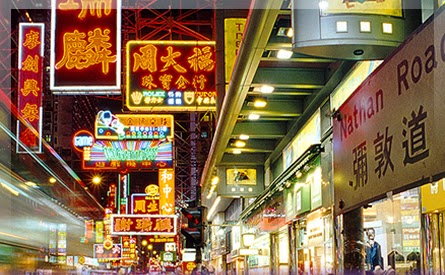
Yet they are bound together by their sheer density, the density of a narrow city wedged between the mountains and the sea. I walked up Nathan Road at night, past rows of old textile factories and towers filled with shoebox apartments, amid an infinite entanglement of glowing Chinese characters.


And on a fine sunny afternoon I took the subway to the north, to where the world's densest human habitation once rose up, a towering slum that is now a park filled with odd chunks of concrete and low-lying tumuli.


I ended my trip atop Victoria Peak, the lush, misty mountain that looms over Central Hong Kong, to see the whole thing at once.

Staring outwards, surrounded by cheery groups of tourists-- Singaporean families, Thai honeymooners, Malaysian retirees. Alone, in my shabby clothes and worn-out sneakers, stubble-faced, without a camera and politely refusing the audio tour, it was impossible not to feel out of place and vaguely suspect.

But what is travel if not dislocation. And this is something people don't talk about very often. And something that becomes all the more salient when you're in a place like Hong Kong, a city with a government predicated on a contradiction, a city that is either self-loathingly Asian or pretentiously Western, either a bastion of democracy in a totalitarian state or the same state's poodle. It is in a place like this, in a situation like this, that the entire world seems to be centered within the field of view of a telescope.