
It's one of those nights when I can't fall asleep, which occur with a dismal regularity these days. I turn a light on and think maybe I should try to read myself to sleep.
But somehow I can't. I pick up a notebook or a glass, and it's transformed, as if it is a simulacrum of the original object. There is something there, something in the way the lamplight casts across the room, something in the angles of the shadows that come in off the street, something in the dull reflection off the cheap leatherette sofa that came with the apartment. I don't know where I am. Suddenly I am transported. On one hand, I know I'm in my room, those are undoubtedly my books on the shelf, that's my handwriting on the grocery list on the counter. But something else has slipped in, and I'm seeing my room as through a veil.
I've been here before. I know it. Maybe you could call it déjà vu, but it's more complex than that. I could tell you everything about this place: the stacks of worn-down cardboard boxes mouldering under the stairs, the cerulean-colored industrial carpeting, the walls of exposed cinder block painted semi-gloss off-white, the 1970s encyclopedias with faux-gilt-edged pages. the rows of books on dark metal shelves, cloth-bound in bright colors with codes of letters and numbers tamped on their spines in white ink. And somewhere, on the other side of a cool, shadowed room, is a plate glass window that faces a little sculpture garden on a vast lawn that runs down to a wide road with traffic shuttling back and forth. Even on a muggy tropical night, its cool, dry climate control chills my arms.
But I don't know whether or not it is a real place. What I know is that inside my head, this room exists, an imaginary library made up of countless other libraries, countless other rooms that I may have once set foot in. The memories have coalesced into a cogent place that I call the library. It needs no further definition.
And it is one of countless spaces that lie embedded in my mind. There is the library. There is the museum, and the billiard room with red wallpaper, the basement, the cabin in mid-winter, the white room and the black room that sit next to each other on a darkened hallway, the sunny terrace by the sea, and so on. These are the spaces I revisit again and again, as familiar as my childhood home. I know them in my earliest memories, in my dreams, on long walks, and on fitful nights when I'm in an odd mood and can't sleep and have nothing else to do but to cycle through the vaguer parts of conscious thought.
Someone like Freud or Jung might try to ascribe meaning to these places, to connect them to specific memories, to complexes, to a mythology of archetypes, to the structure of id, ego, and superego. But I'm not so sure how valid those ideas are.
And there are the various schools of cognitive science that suggest that we have certain evolved capacities that lead to certain aesthetic sensibilities, or at the very least, that our brains have evolved to process information is fairly specific ways. And I find these ideas just as groundless and speculative as those of the analysts.
So I am left with a set of lonely rooms, with their variations in color and light and shadow, inscrutable and omnipresent. I don't know where they come from, but I see their manifestations everywhere, in a fanlight, in a chess set.
Consequently, when I wander around the city, I am also wandering around in my own psyche. Even when I walk down a completely new street, it's already all silted up with nostalgia.
Our lives are couched in an invisible network of signs and cryptic meanings. The curvilinear font of a street sign, the gingerbread on the eaves of an old house, the angle of a roofline, a cluster of casuarina trees, each of them is imbued with a million narratives.
And, every once in a while, the vague, flickering images we carry in our minds harmonize with the stories of our built environment. We look up, and we are, for a few seconds, transported.
But it's only for a brief moment. I am in my library, my museum, my sunny terrace by the sea for only five seconds, and then it dissipates. Maybe it comes to me in waves, but each wave is only momentary, before they subside entirely, and I am again alone on a quiet street.
Tuesday, April 9, 2013

Monday, March 11, 2013
The Idea of East
The idea strikes me at odd moments. It hits me now, as a pale shaft of morning light casts across the floor, to an old wooden double door with an unpainted latch leading to a crawlspace in a tiny Muslim school. Its shape, its state of decrepitude, its rough-cut and hand-adzed quality, its position beneath an eight-paned transom window of pebbled glass: all of them seem to exemplify that idea of the Asiatic.
And when I try to figure out where this idea came from, it seems to be something I had a very early acquaintance with. Some sources are obvious-- the vast, reconstructed Chinese temple at the Nelson-Atkins Museum in Kansas City comes to mind, a vast and hollow space lined with immense murals, accompanied by display cases with nephrite Buddhas, lacquered plates, celadon cups, cricket cages.
But others are more intimate and in many ways less direct-- a certain wooden drawer, an embroidered piece of silk, the opium weight shaped like a metallic rooster my parents used to put their bills under. The memories of a bourgeois childhood seem to be made up of all these tiny little marginalia, arranged in my mind so neatly, like a Joseph Cornell box.
And more mysteriously, there were whole classes of gastronomy, of music, of aroma, of image that seemed to fall under the rubric of the Oriental. As a child, the whole world seems to consist of these wholly irrational and vaguely defined gestalts, tendencies without clear origins-- a mode of thinking we can immediately revert to with the assistance of a little psilocybin, but still seeps into our adult lives. All I need to hear is a certain scale on a song playing on a distant radio, or taste the bitter, ferric flavor of water chestnuts directly out of the can, and I can trigger the gestalt of the "Eastern."
And it was a gestalt I was powerfully attracted to. On the map and on the news: Borneo and Makassar, Rangoon and Vientiane, Dien Bien Phu and Irian Jaya-- whole names that evoked a sun rising slowly over a turbid, brown river, egrets in palm trees, the morning processions of wizened monks, silhouetted against a vermilion dawn.
But of course this perception has little to do with the reality of life in Asia. And of course it holds little currency beyond childhood. Areas of Bangkok are more Californian than California, the new skyscrapers of China and the Persian Gulf states are designed by London and New York firms. Singapore, Dubai, Shanghai, Shenzhen, and Hong Kong now embody the excesses of American-style capitalism. Which of course is nothing new. There are the Greek statues being dug up in the old Buddhist kingdoms of Pakistan, and the Portuguese-inspired desserts sold on the streets of Bangkok.
True, huge numbers of adults-- distressingly, a huge number of them in Asian, European, and North American governments-- still cling to the notions of "East" and "West," but this distinction has been thoroughly and successfully demolished by any number of big-name intellectuals. We can decode the sign systems that connote "Easternness" in society and media, and demonstrate how they're crassly used to market consumer goods and politics to an unwitting public. We can chart the history of the idea of the "Oriental" and see how it was used as a pretext for racism and colonialism. Simply put, there is no East there. But the phenomenon of East is out there, even if it's unhealthy to ascribe a material truth-value to it.
It haunts me. As much as I want to move beyond the idea of East, to base my perceptions on materiality and evidence, it's hard to escape the daydreams of my seven year old self. And that's a form of dishonesty that especially annoys me, when people claim their own nostalgias to be the basis for impersonal truth.
So I try to simply be aware of the phenomenon, to recognize its existence as a phantom image, one of the narratives and myths-- some benign, some invidious-- we tell ourselves in a clawing effort to make sense of the world.
And now that I live in Asia, I can start to build a new narrative, a new story that I actually can ground in my day-to-day life, in the ordinary lives of the millions of people around me, their habits and quirks and beliefs and dreams. The veil is falling off, and I can start anew. I start with something simple and beguiling: the street outside, filled with fallen bougainvillea blossoms.
And when I try to figure out where this idea came from, it seems to be something I had a very early acquaintance with. Some sources are obvious-- the vast, reconstructed Chinese temple at the Nelson-Atkins Museum in Kansas City comes to mind, a vast and hollow space lined with immense murals, accompanied by display cases with nephrite Buddhas, lacquered plates, celadon cups, cricket cages.
But others are more intimate and in many ways less direct-- a certain wooden drawer, an embroidered piece of silk, the opium weight shaped like a metallic rooster my parents used to put their bills under. The memories of a bourgeois childhood seem to be made up of all these tiny little marginalia, arranged in my mind so neatly, like a Joseph Cornell box.
And more mysteriously, there were whole classes of gastronomy, of music, of aroma, of image that seemed to fall under the rubric of the Oriental. As a child, the whole world seems to consist of these wholly irrational and vaguely defined gestalts, tendencies without clear origins-- a mode of thinking we can immediately revert to with the assistance of a little psilocybin, but still seeps into our adult lives. All I need to hear is a certain scale on a song playing on a distant radio, or taste the bitter, ferric flavor of water chestnuts directly out of the can, and I can trigger the gestalt of the "Eastern."
And it was a gestalt I was powerfully attracted to. On the map and on the news: Borneo and Makassar, Rangoon and Vientiane, Dien Bien Phu and Irian Jaya-- whole names that evoked a sun rising slowly over a turbid, brown river, egrets in palm trees, the morning processions of wizened monks, silhouetted against a vermilion dawn.
But of course this perception has little to do with the reality of life in Asia. And of course it holds little currency beyond childhood. Areas of Bangkok are more Californian than California, the new skyscrapers of China and the Persian Gulf states are designed by London and New York firms. Singapore, Dubai, Shanghai, Shenzhen, and Hong Kong now embody the excesses of American-style capitalism. Which of course is nothing new. There are the Greek statues being dug up in the old Buddhist kingdoms of Pakistan, and the Portuguese-inspired desserts sold on the streets of Bangkok.
True, huge numbers of adults-- distressingly, a huge number of them in Asian, European, and North American governments-- still cling to the notions of "East" and "West," but this distinction has been thoroughly and successfully demolished by any number of big-name intellectuals. We can decode the sign systems that connote "Easternness" in society and media, and demonstrate how they're crassly used to market consumer goods and politics to an unwitting public. We can chart the history of the idea of the "Oriental" and see how it was used as a pretext for racism and colonialism. Simply put, there is no East there. But the phenomenon of East is out there, even if it's unhealthy to ascribe a material truth-value to it.
It haunts me. As much as I want to move beyond the idea of East, to base my perceptions on materiality and evidence, it's hard to escape the daydreams of my seven year old self. And that's a form of dishonesty that especially annoys me, when people claim their own nostalgias to be the basis for impersonal truth.
So I try to simply be aware of the phenomenon, to recognize its existence as a phantom image, one of the narratives and myths-- some benign, some invidious-- we tell ourselves in a clawing effort to make sense of the world.
And now that I live in Asia, I can start to build a new narrative, a new story that I actually can ground in my day-to-day life, in the ordinary lives of the millions of people around me, their habits and quirks and beliefs and dreams. The veil is falling off, and I can start anew. I start with something simple and beguiling: the street outside, filled with fallen bougainvillea blossoms.
Tuesday, February 26, 2013
The Weight of Signs
On hungover Sunday mornings, I've taken to going on long walks through the shopping malls of Bangkok. One can find secret passageways, down long, white hallways, across hot asphalt alleyways, between littered chicken bones and smashed mangoes. Somehow the world becomes less pressing-- the things you regret from last night, the noonday sun-- when you're in an air-conditioned bubble with so much sensory stimulus that you don't have to choose any one thing. Simply turn your brain off, listen to your headphones and get lost in the white noise.
Which is how I wound up at Center One, one of the handful of cheap, chaotic shopping centers clustered around the Victory Monument. In a city where the large-scale malls inspire the same degree of devotion as the golden temples of the old city, this is but a minor shrine-- a few chain restaurants, mobile phone shops, and cosmetic counters, all fitting its location next to a large technical school. But far more than anything else, there are the countless tiny vendor stalls with their piles of women's clothes.
Each shop has its name written in balloon-shaped Roman script, and each is a testament to the truly awful taste of petit-bourgeois Thai teenagers. In every stall, you see the same merchandise-- giant Minnie Mouse bows, knock-offs of dresses worn by K-pop stars, gaudy costume jewelry, gathered together in cluttered racks and particle-board discount bins.
What I find repulsive about these isn't the cheap fabric and general ugliness-- I'll leave those critiques to more fashionable people than myself-- but the sort of transcendental image that they're trying to project. A lot of this is an import from Northeast Asia. Within the Japanese sphere of economic influence, Tokyo necessarily expanded its aesthetic values to the then underdeveloped states of Southeast Asia in the years around the Second World War. And this sort of kawaii or proto-kawaii attitude has permeated international pop culture in Thailand since then, from Japanese enka singers back during the '40s and '50s to the modern hallyu-- the Korean wave of pop stars, fashion, and soap opera.
And in that mall basement, it strikes me as especially garish. The women are giggling schoolgirls-- eternal virgins wrapped in ribbon. They pair perfectly with the men-- passive, kittenish, heavily made-up male teen idols with perfectly coiffed hair and plastic surgery to give them occidental features. Combined, it is a pop culture idiom that blends the moronic adolescent consumerism of my own country with the bitterly hierarchical Confucianism practiced on the shores of the East China Sea.
I want to sit down, and wind up at a chain restaurant, with a strawberry smoothie with more refined sugar than strawberries in it.
And I have to realize that despite my own opinions, despite my attempts to learn a language, to be a part of another country, I remain so explicitly an outsider, not only through the color of my skin and hair, but through my own sense of otherness. When I'm in an American shopping mall, I can scoff all I want, but I can comfortably read the semiotics of it. But here, I barely know what I'm looking at. Not only am I alienated from consumer society as a whole, but from the form that consumer society has taken in a culture on the far side of the planet.
I'd like to think that my response is one of good taste versus bad taste... that not only am I responding viscerally, but that I'm pursuing a line of thought in the tradition of Adorno's critique of the culture industry, the Marxist and Gramscian critique of the commodity fetish, and Veblen's studies of the leisure class. These are claims that I can make with far greater confidence back in the States. But especially when I'm less aware of the sign systems being processed, I start to think that my political readings of the aesthetic are simply an intellectual smokescreen. Rather than making a lucid analysis, I'm terrified that I'm simply deeming my own bias and ennui to be an absolute truth.
This is the trap into which I fall. Everything is shaded thusly. Depression becomes reasonable acceptance of life in a late-capitalist society. Happiness becomes collaboration with the invidious forces of primitive accumulation. Loneliness is our natural state in an atomized modernity.
Of course there are countless antidotes to such a way of thinking-- religious people take faith in the idea of otherworldly salvation, capitalist enthusiasts make dubious claims about the equally otherworldly "free market," bohemian types choose to simply to inhabit a bubble, and certain types of postmodernist try to celebrate the hybrid and the liminal-- all of which seem equally lonely and/or defeatist.
I sit in my corner, hide out with my book a little bit. And then when I leave the mall I walk out into the late afternoon in Santiphap Park. Old couples picnic by the little pond, a few workmen tearing down the old love motel on Rangnam take a smoke break on the far soi. And stepping out into fresh air, the signs rearrange themselves into something more cogent. And I am here, in a port city of 15 million people, and like the countless others who pass through here I'm trying to make sense of it, trying to extract some kind of meaning.
A light rain starts to fall, and this is one of those moments, when the whole city opens up like a flower at sunrise, and it, for 30 seconds, is just as lovely.
Which is how I wound up at Center One, one of the handful of cheap, chaotic shopping centers clustered around the Victory Monument. In a city where the large-scale malls inspire the same degree of devotion as the golden temples of the old city, this is but a minor shrine-- a few chain restaurants, mobile phone shops, and cosmetic counters, all fitting its location next to a large technical school. But far more than anything else, there are the countless tiny vendor stalls with their piles of women's clothes.
Each shop has its name written in balloon-shaped Roman script, and each is a testament to the truly awful taste of petit-bourgeois Thai teenagers. In every stall, you see the same merchandise-- giant Minnie Mouse bows, knock-offs of dresses worn by K-pop stars, gaudy costume jewelry, gathered together in cluttered racks and particle-board discount bins.
What I find repulsive about these isn't the cheap fabric and general ugliness-- I'll leave those critiques to more fashionable people than myself-- but the sort of transcendental image that they're trying to project. A lot of this is an import from Northeast Asia. Within the Japanese sphere of economic influence, Tokyo necessarily expanded its aesthetic values to the then underdeveloped states of Southeast Asia in the years around the Second World War. And this sort of kawaii or proto-kawaii attitude has permeated international pop culture in Thailand since then, from Japanese enka singers back during the '40s and '50s to the modern hallyu-- the Korean wave of pop stars, fashion, and soap opera.
And in that mall basement, it strikes me as especially garish. The women are giggling schoolgirls-- eternal virgins wrapped in ribbon. They pair perfectly with the men-- passive, kittenish, heavily made-up male teen idols with perfectly coiffed hair and plastic surgery to give them occidental features. Combined, it is a pop culture idiom that blends the moronic adolescent consumerism of my own country with the bitterly hierarchical Confucianism practiced on the shores of the East China Sea.
I want to sit down, and wind up at a chain restaurant, with a strawberry smoothie with more refined sugar than strawberries in it.
And I have to realize that despite my own opinions, despite my attempts to learn a language, to be a part of another country, I remain so explicitly an outsider, not only through the color of my skin and hair, but through my own sense of otherness. When I'm in an American shopping mall, I can scoff all I want, but I can comfortably read the semiotics of it. But here, I barely know what I'm looking at. Not only am I alienated from consumer society as a whole, but from the form that consumer society has taken in a culture on the far side of the planet.
I'd like to think that my response is one of good taste versus bad taste... that not only am I responding viscerally, but that I'm pursuing a line of thought in the tradition of Adorno's critique of the culture industry, the Marxist and Gramscian critique of the commodity fetish, and Veblen's studies of the leisure class. These are claims that I can make with far greater confidence back in the States. But especially when I'm less aware of the sign systems being processed, I start to think that my political readings of the aesthetic are simply an intellectual smokescreen. Rather than making a lucid analysis, I'm terrified that I'm simply deeming my own bias and ennui to be an absolute truth.
This is the trap into which I fall. Everything is shaded thusly. Depression becomes reasonable acceptance of life in a late-capitalist society. Happiness becomes collaboration with the invidious forces of primitive accumulation. Loneliness is our natural state in an atomized modernity.
Of course there are countless antidotes to such a way of thinking-- religious people take faith in the idea of otherworldly salvation, capitalist enthusiasts make dubious claims about the equally otherworldly "free market," bohemian types choose to simply to inhabit a bubble, and certain types of postmodernist try to celebrate the hybrid and the liminal-- all of which seem equally lonely and/or defeatist.
I sit in my corner, hide out with my book a little bit. And then when I leave the mall I walk out into the late afternoon in Santiphap Park. Old couples picnic by the little pond, a few workmen tearing down the old love motel on Rangnam take a smoke break on the far soi. And stepping out into fresh air, the signs rearrange themselves into something more cogent. And I am here, in a port city of 15 million people, and like the countless others who pass through here I'm trying to make sense of it, trying to extract some kind of meaning.
A light rain starts to fall, and this is one of those moments, when the whole city opens up like a flower at sunrise, and it, for 30 seconds, is just as lovely.
Tuesday, February 12, 2013
The Ruins of the Contemporary World
At least a couple times a week, I find myself on the highway that extends north from the Din Daeng area of Bangkok towards Don Mueang Airport, through a set of dismal, sprawling nowhere suburbs, past minor government ministries, bottling plants, overgrown cane fields, and gravel lots filled with abandoned buses. And immediately to the west, it is impossibly not to notice the concrete arches and columns that flank the railroad tracks. Most people assume at first that they are a project under construction-- a new highway, or a new metro line.
At first, they seem to be blank, geometric abstractions, their purpose uncertain. But as their function faded over the years, their form took precedence. One has a stencil at its base, another bristles with rusted, cement-daubed rebar. Like the terra cotta soldiers at Xi'an, their seemingly identical profiles reveal their personalities on close inspection, and you see the individual features of each pillar.

This, in the dizzy years of the Thai Economic Miracle in the late '80s and early '90s, was the first stage of the Hopewell Project, a planned high-speed rail and road route to link the Hua Lamphong Railway Station to what was then Bangkok's primary airport. The project was suspended under the Anand Panyarachun government, but was still considered a viable plan until 1997.
But after the 1997 devaluation of the baht and the accompanying collapse of most East and Southeast Asian economies, the remnants became a stark reminder of overexuberance and its consequences, an ugly precipitate of the business cycle.
But they aren't alone. Bangkok is a city of abandoned spires, of half-completed office towers and unfinished condos, its skyline broken by the gray hulks of stillborn development. And there are the projects abandoned in the earliest stages-- fields littered with concrete stakes, drained marshes with lonely cracked, asphalt roads leading into their depths-- that are as oblique and mysterious as pictographs in the desert.
It reminds me, rather, of California City-- the radically failed attempt at grand-scale modernist urban planning in the Mojave Desert. Or, more contemporarily, to the half-built suburbs that blight the edge of countless Sun Belt cities, my own home nation's equivalents of Bangkok's unfinished ruins. What could be lonelier, more fatalistic than those cul-de-sacs-- the heart of America's white-picket-fence collective fantasy-- falling to pieces amid an arid wasteland?

We don't want to see the vision of the contemporary world-- something so embodied by the image of the modern skyline (and, to a lesser extent, the superhighway and the mega-suburb)-- already going decrepit. It remind us too much of the not-too-distant era in the future when everything we inhabit will be relegated to the history books, or simply forgotten.
But it seems to me that these remnants are almost essential to contemporary life. In a neoliberal economic landscape marked by radical concentrations of wealth, abrupt crashes, and the celebration of massive fiscal risk as a healthy manifestation of the investor's animal spirit, they are in one way not images of our world destroyed, but our world distilled.
A final question: how long will the ruins remain where they are? Built with the latest techniques of concrete reinforcement, they aren't easy to demolish, and some of them remain quite structurally sound. Eventually someone will come along and clear them, no doubt. But part of me-- any pragmatic considerations of economics, safety, local wishes, and urban aesthetics aside-- wants the city to keep them as somber reminders. They are a network of monuments, commemorating this era's desire and greed, and ultimately, its fate.
At first, they seem to be blank, geometric abstractions, their purpose uncertain. But as their function faded over the years, their form took precedence. One has a stencil at its base, another bristles with rusted, cement-daubed rebar. Like the terra cotta soldiers at Xi'an, their seemingly identical profiles reveal their personalities on close inspection, and you see the individual features of each pillar.

This, in the dizzy years of the Thai Economic Miracle in the late '80s and early '90s, was the first stage of the Hopewell Project, a planned high-speed rail and road route to link the Hua Lamphong Railway Station to what was then Bangkok's primary airport. The project was suspended under the Anand Panyarachun government, but was still considered a viable plan until 1997.
But after the 1997 devaluation of the baht and the accompanying collapse of most East and Southeast Asian economies, the remnants became a stark reminder of overexuberance and its consequences, an ugly precipitate of the business cycle.
But they aren't alone. Bangkok is a city of abandoned spires, of half-completed office towers and unfinished condos, its skyline broken by the gray hulks of stillborn development. And there are the projects abandoned in the earliest stages-- fields littered with concrete stakes, drained marshes with lonely cracked, asphalt roads leading into their depths-- that are as oblique and mysterious as pictographs in the desert.
It reminds me, rather, of California City-- the radically failed attempt at grand-scale modernist urban planning in the Mojave Desert. Or, more contemporarily, to the half-built suburbs that blight the edge of countless Sun Belt cities, my own home nation's equivalents of Bangkok's unfinished ruins. What could be lonelier, more fatalistic than those cul-de-sacs-- the heart of America's white-picket-fence collective fantasy-- falling to pieces amid an arid wasteland?
We don't want to see the vision of the contemporary world-- something so embodied by the image of the modern skyline (and, to a lesser extent, the superhighway and the mega-suburb)-- already going decrepit. It remind us too much of the not-too-distant era in the future when everything we inhabit will be relegated to the history books, or simply forgotten.
But it seems to me that these remnants are almost essential to contemporary life. In a neoliberal economic landscape marked by radical concentrations of wealth, abrupt crashes, and the celebration of massive fiscal risk as a healthy manifestation of the investor's animal spirit, they are in one way not images of our world destroyed, but our world distilled.
A final question: how long will the ruins remain where they are? Built with the latest techniques of concrete reinforcement, they aren't easy to demolish, and some of them remain quite structurally sound. Eventually someone will come along and clear them, no doubt. But part of me-- any pragmatic considerations of economics, safety, local wishes, and urban aesthetics aside-- wants the city to keep them as somber reminders. They are a network of monuments, commemorating this era's desire and greed, and ultimately, its fate.
Thursday, January 24, 2013
The Museum of Inverse Reality
Every day we walk through the same spaces. We move from the bedroom into the living room, in and out of the front door. There is the same train to work, the same train home. Objects are rearranged, they appear and disappear. The impression changes with weather and light, from morning to evening, and subjectively with our moods, but mostly our relationship to the places we inhabit is one of reiteration, one of appearance repeated again and again until we cease to even recognize their forms.
Which is why, as I stared into the glass-top table of a softly lit cafe, I was so stunned to see a world I'd forgotten about.
Like so many children, I'd spent what seemed like hours looking at the world upside down. Lying, feet up, on a worn armchair, I saw an entirely different room than the one I ran and played in.
Looking into the reflection on the tabletop, I was looking into a portal, a portal on another reality, and a portal on a reality I once held dear. Here were hanging lamps standing as straight as crinoids on the sea floor, fluorescent light fixtures like low-slung Japanese tables, the long white rectangular benches formed by ceiling beams, clocks tapering at a downward facing noon.
The world as I knew it was full of scattered things, stacks of books on coffee tables, dusty lines of ash gathered around the hearth. But the inverse possessed clean lines and spare white corners and immaculate 90 degree angles. Every object accreted into a ceiling, something you only noticed if you looked up. And the inverse was not so much a true inversion as an abstraction. Suddenly, everything was stripped of its conventional meaning and reduced to an inscrutable form with the texture and shape of modern sculpture.
It was a sort of space I only associated with the museum, a chilly and sparse emptiness filled with holy relics. And so when I went into the inverse, I was entering into a very personal museum, the air conditioning turned on too high, filled with the faint, smoky smell of a disused fireplace in summer.
As I grew older-- too tall and ungainly to curl up on a beat up antique chair, too busy to spend my time in a fantasy-- I stopped staring into the inverse. But occasionally I would get a glimpse.
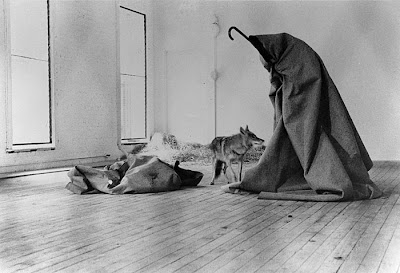
There was Joseph Beuys, with his crude assemblages of felt and rough-hewn pine standing isolated in a white gallery. And that, of course, was my parents' threadbare rug and the stacks of firewood in a tarnished brass carrier.
There was René Magritte, an impeccable composer of steam trains in bourgeois parlors, sunny days by the Côte d'Azur during which pieces of balsa are conjured up in thin air, lonely poplar trees that seem to grow on other planets, their leaves lit by strange moons.

And there was Giorgio De Chirico, with his empty piazzas and cylindrical towers, casting long shadows on an eternal late afternoon in a nameless Italian town.

What binds them all is a sense of the metaphysical. Narrative is absent. In its place is an infinite spiderweb of signifiers and signified, automatic response, hidden meanings, miscommunication, unsolvable mystery, structures as peculiar as the constellations, painted faces as enigmatic as playing card royalty.
Of course our aesthetic sense changes over the course of a lifetime. But there are certain things we can trace to specific initial events. I walk through the halls of museums in London, Saint Louis, Kuala Lumpur, down white passageways, past massive plate glass windows and Barcelona chairs. I stop before paintings and video loops, and I can look at them, appreciate the technical effort of their composition, fix their place in the continuum of art history. But then I stumble upon something. And suddenly, I'm transported to the imaginary museum, and I'm face to face with inverse reality. Once, I used to hide there.
Which is why, as I stared into the glass-top table of a softly lit cafe, I was so stunned to see a world I'd forgotten about.
Like so many children, I'd spent what seemed like hours looking at the world upside down. Lying, feet up, on a worn armchair, I saw an entirely different room than the one I ran and played in.
Looking into the reflection on the tabletop, I was looking into a portal, a portal on another reality, and a portal on a reality I once held dear. Here were hanging lamps standing as straight as crinoids on the sea floor, fluorescent light fixtures like low-slung Japanese tables, the long white rectangular benches formed by ceiling beams, clocks tapering at a downward facing noon.
The world as I knew it was full of scattered things, stacks of books on coffee tables, dusty lines of ash gathered around the hearth. But the inverse possessed clean lines and spare white corners and immaculate 90 degree angles. Every object accreted into a ceiling, something you only noticed if you looked up. And the inverse was not so much a true inversion as an abstraction. Suddenly, everything was stripped of its conventional meaning and reduced to an inscrutable form with the texture and shape of modern sculpture.
It was a sort of space I only associated with the museum, a chilly and sparse emptiness filled with holy relics. And so when I went into the inverse, I was entering into a very personal museum, the air conditioning turned on too high, filled with the faint, smoky smell of a disused fireplace in summer.
As I grew older-- too tall and ungainly to curl up on a beat up antique chair, too busy to spend my time in a fantasy-- I stopped staring into the inverse. But occasionally I would get a glimpse.
There was Joseph Beuys, with his crude assemblages of felt and rough-hewn pine standing isolated in a white gallery. And that, of course, was my parents' threadbare rug and the stacks of firewood in a tarnished brass carrier.

There was René Magritte, an impeccable composer of steam trains in bourgeois parlors, sunny days by the Côte d'Azur during which pieces of balsa are conjured up in thin air, lonely poplar trees that seem to grow on other planets, their leaves lit by strange moons.

And there was Giorgio De Chirico, with his empty piazzas and cylindrical towers, casting long shadows on an eternal late afternoon in a nameless Italian town.

What binds them all is a sense of the metaphysical. Narrative is absent. In its place is an infinite spiderweb of signifiers and signified, automatic response, hidden meanings, miscommunication, unsolvable mystery, structures as peculiar as the constellations, painted faces as enigmatic as playing card royalty.
Of course our aesthetic sense changes over the course of a lifetime. But there are certain things we can trace to specific initial events. I walk through the halls of museums in London, Saint Louis, Kuala Lumpur, down white passageways, past massive plate glass windows and Barcelona chairs. I stop before paintings and video loops, and I can look at them, appreciate the technical effort of their composition, fix their place in the continuum of art history. But then I stumble upon something. And suddenly, I'm transported to the imaginary museum, and I'm face to face with inverse reality. Once, I used to hide there.
Monday, January 7, 2013
Christmas in the Province of the Million Rice Fields
Chiang Mai is a city within an image. To the outside world, it is a city of mists and golden stupas, nested in the lofty Thongchai Mountains, and encircled by its ancient brick walls and jade-green moat. This romantic vision is propagated within Thailand by countless romance movies and airline promotional packages; internationally, it's propagated by the Lonely Planet guidebook, that comically misinformed and sloppily written vade mecum of the Khaosan set.
I'd visited Chiang Mai a couple of years previous, and remembered it as a sort of Asian parallel to Santa Fe: the same old hippies parked at vegetarian restaurants, the same young hippies riding bikes shirtless, the same cozy used bookstores and mountain views, the same hemp bags and long cotton scarves, the same elderly tribeswomen peddling silver trinkets, and the same galleries selling cloying tourist art.
But as I stepped out into the slightly chill evening air on Christmas Eve, I found the town far more tawdry and knockabout than I'd remembered. The crumbling laterite chedis and teakwood verandahs were overwhelmed by all manner of architectural detritus: boxy insensitivities, commercialized fake deconstructivism, extruded-aluminum imitations of traditional Northern-Thai rooflines. Following an alley just outside the moat, I walked down streets I vaguely recalled from a whiskey-laden Songkran festival. Most of the bars and restaurants I had eaten and drank at were empty, save for the occasional grotesquely fat white man, perhaps accompanied by a troglodytic Thai wife.
Lost in the back alleys, the same storefronts kept recurring: the empty restaurants with solitary, obese Western customers, all of them with high ceilings and lone fluorescent lights, their only decoration a calendar with a picture of the monarch; food stalls with piles of limp cabbages and velvety curtains of tripe hanging inside a refrigerator case, pools of stagnant, stinking water accumulating on the pavement; dimly lit brothels, their windows blacked out, illuminated by rainbow-colored Christmas lights; dark, jungly parkways with uneven sidewalks; bearded European backpackers smoking hand-rolled cigarettes in front of their hostels.
Every street seemed a dejection. Row after row of guesthouses all promoted the same activities. The adrenaline-laced extreme sports they offered seemed to differ from ordinary sports only in their requirement of hundreds of dollars of technology. And the "hill tribe trekking" that is ubiquitously promoted revealed itself to be nothing more than a bunch of privileged, predominantly white youth regarding the indigenous people as safari-park creatures in their native habitat.
The grotesquerie of posters advertising the human zoo was doubled by the sight of impoverished Hmong and Karen, either displaying their wares on blankets or simply panhandling. The Thai bourgeoisie romanticizes their own tribal populace with the same vigor that the American bourgeoisie romanticize theirs, fetishizing their, oh, simplicity and building the occasional school while at the same time turning a cheery blind eye to the crass exploitation of their home regions by corporate entities (Western, other Asian, and local alike), the militant spread of evangelical Christianity through coercive tactics, and the routine export of local women to the fleshpots of Bangkok.
Despondent, I looked for someplace to sit down and maybe get some reading or writing done, have an antisocial drink, watch some band of local hacks play Creedence Clearwater covers, whatever.
Which is how I wound up at a French cafe-bar on a terrace adjacent to the city's night bazaar. The annoyances-- women trying to sell wooden frogs, that asshole Michael Bublé on the TV-- made themselves known, but for the most part, I could just concentrate on the beer in front of me, the marble-top table, the lights strung up in the palms.
And then from behind a fountain, a Thai marching band strikes up into a Christmas carol. All those songs that in America I find to be obnoxious and overdone are suddenly rather sweet when they're played by middle-aged Buddhists below the Tropic of Cancer.
These are the unexpected delights of going someplace else. Of course we expect to see things we haven't seen before, meet new people, eat new foods, walk down unfamiliar streets. But hidden within the unknown is that which is known, suddenly re-imagined. And, what is better, something you found so tired and dull and insipid suddenly given new life. You find traces of another time, another place enveloped in entirely different circumstances, and suddenly everything is brought into slightly sharper relief.
I'd visited Chiang Mai a couple of years previous, and remembered it as a sort of Asian parallel to Santa Fe: the same old hippies parked at vegetarian restaurants, the same young hippies riding bikes shirtless, the same cozy used bookstores and mountain views, the same hemp bags and long cotton scarves, the same elderly tribeswomen peddling silver trinkets, and the same galleries selling cloying tourist art.
But as I stepped out into the slightly chill evening air on Christmas Eve, I found the town far more tawdry and knockabout than I'd remembered. The crumbling laterite chedis and teakwood verandahs were overwhelmed by all manner of architectural detritus: boxy insensitivities, commercialized fake deconstructivism, extruded-aluminum imitations of traditional Northern-Thai rooflines. Following an alley just outside the moat, I walked down streets I vaguely recalled from a whiskey-laden Songkran festival. Most of the bars and restaurants I had eaten and drank at were empty, save for the occasional grotesquely fat white man, perhaps accompanied by a troglodytic Thai wife.
Lost in the back alleys, the same storefronts kept recurring: the empty restaurants with solitary, obese Western customers, all of them with high ceilings and lone fluorescent lights, their only decoration a calendar with a picture of the monarch; food stalls with piles of limp cabbages and velvety curtains of tripe hanging inside a refrigerator case, pools of stagnant, stinking water accumulating on the pavement; dimly lit brothels, their windows blacked out, illuminated by rainbow-colored Christmas lights; dark, jungly parkways with uneven sidewalks; bearded European backpackers smoking hand-rolled cigarettes in front of their hostels.
Every street seemed a dejection. Row after row of guesthouses all promoted the same activities. The adrenaline-laced extreme sports they offered seemed to differ from ordinary sports only in their requirement of hundreds of dollars of technology. And the "hill tribe trekking" that is ubiquitously promoted revealed itself to be nothing more than a bunch of privileged, predominantly white youth regarding the indigenous people as safari-park creatures in their native habitat.
The grotesquerie of posters advertising the human zoo was doubled by the sight of impoverished Hmong and Karen, either displaying their wares on blankets or simply panhandling. The Thai bourgeoisie romanticizes their own tribal populace with the same vigor that the American bourgeoisie romanticize theirs, fetishizing their, oh, simplicity and building the occasional school while at the same time turning a cheery blind eye to the crass exploitation of their home regions by corporate entities (Western, other Asian, and local alike), the militant spread of evangelical Christianity through coercive tactics, and the routine export of local women to the fleshpots of Bangkok.
Despondent, I looked for someplace to sit down and maybe get some reading or writing done, have an antisocial drink, watch some band of local hacks play Creedence Clearwater covers, whatever.
Which is how I wound up at a French cafe-bar on a terrace adjacent to the city's night bazaar. The annoyances-- women trying to sell wooden frogs, that asshole Michael Bublé on the TV-- made themselves known, but for the most part, I could just concentrate on the beer in front of me, the marble-top table, the lights strung up in the palms.
And then from behind a fountain, a Thai marching band strikes up into a Christmas carol. All those songs that in America I find to be obnoxious and overdone are suddenly rather sweet when they're played by middle-aged Buddhists below the Tropic of Cancer.
These are the unexpected delights of going someplace else. Of course we expect to see things we haven't seen before, meet new people, eat new foods, walk down unfamiliar streets. But hidden within the unknown is that which is known, suddenly re-imagined. And, what is better, something you found so tired and dull and insipid suddenly given new life. You find traces of another time, another place enveloped in entirely different circumstances, and suddenly everything is brought into slightly sharper relief.
Thursday, December 20, 2012
Existential Boredom
Life becomes a set of repetitions. There are the long taxi rides, moving through traffic up and down Vibhavadi Rangsit. There are the walks to the corner food stall, via the little bridge over the filthy, twilight-darkened canal, as the men in blue workshirts are just getting off their shifts at the printers' shops on Phra Ram 6.
And I know this is supposed to be a brilliant equatorial metropolis, a city hemmed in by crystalline beaches and perfumed jungles, a city of unparallelled vibrancy (as the glossy travel magazines are wont to put it), where all pleasures can be had at the wink of an eye and the drop of a coin.
But what they don't tell you about places like this is how fucking boring the nightclubs and the beach towns can be. Beyond being tragic or even pathetic, the bargirls and the sexpats and the backpackers and the fugitives are by and large just so goddamn dull. The dullness starts here, and bleeds over into everyday life.
Now, there are boredoms that can be remedied and there are those that cannot. The boredom of sitting around one's apartment can be resolved by going for a walk, putting on a movie, reading a book, whatever. And there is also the boredom of long waits at train stations and hour-long meetings. This boredom is conditioned entirely by circumstance, and is often defined by spatial and temporal constraints. You're stuck in this one place at this one time, and it's not a place you want to be.
But there is also a third form that defies easy categorization, and is far more insidious than either. It is the unresolvable boredom that is unconditioned, a melancholy and existential boredom. This is what occurs when you flip through every channel on the TV and they all seem equally dull and crass. Existential boredom is marked by its sense of inescapability. You look around yourself, and everything presents itself with a harshness and a clarity, as if it's being illuminated by an industrial-sized fluorescent light.
Existential boredom is experienced quite differently by those who are rooted and those who are rootless, to draw a suspect but convenient distinction.
For the "rooted," existential boredom might present itself as an unsatisfying career or a loveless marriage. They think they might be able to fix the situation by quitting their job, getting a divorce, or moving to a new town.
But for those of us who don't have as many solid connections, we can't really draw that conclusion. And I think this explains the cynicism of so many rootless types, because there is this awful and nagging suspicion that things will never get better, and that we're doomed to repeat our motions again and again, in slightly different circumstances, like a set of piano variations carrying on into infinity.
Eternal tourists seem to keep moving because there's nothing else to do. It's not that they/we/whatever think that the next stop will necessarily resolve the ennui, but maybe there's something unnameable and unknowable, however distant it might be.
My mind is drawn back to the legend of Tantalus, who in Greek myth spent the afterlife in a lake beneath a plum tree. When he reached up for a piece of fruit, the branches would raise up. And when he bent down for a drink, the waters would recede.
During the Dark Ages, theologians like Evgarius of Pontus, commented on the monastic hermits that lived in the harsh regions along the Black Sea coast. Alone with their thoughts, their minds so often didn't turn inwards, towards the heavenly father that scholastic thinkers believed was reachable through wisdom and logic, but towards a darker place. Lonely, slothful, and restless, they fell slack in their clerical duties and eventually stopped living like humans altogether. Acedia, Evgarius called it.
And this was believed to be a laziness, a refusal to take the effort to know Christ, and an intentional turning away from all that was good and right and humane.
What this point of view gets right is that the state of acedia is as much as anything else a temptation. When one accepts everything fading to gray, there is a certain peacefulness, a letting go. And it provides a justification for one's own unhappiness-- a depressive realism, as certain psychiatrists call it.
So we find whatever bright spots we have as a way of taking solace-- the sun setting over the Olympic Mountains, a box of faded photographs, the smile of someone next to you in bed in the blue light before sunrise, a book of Flannery O'Connor short stories, a white ceramic cup of jasmine tea.
And I know this is supposed to be a brilliant equatorial metropolis, a city hemmed in by crystalline beaches and perfumed jungles, a city of unparallelled vibrancy (as the glossy travel magazines are wont to put it), where all pleasures can be had at the wink of an eye and the drop of a coin.
But what they don't tell you about places like this is how fucking boring the nightclubs and the beach towns can be. Beyond being tragic or even pathetic, the bargirls and the sexpats and the backpackers and the fugitives are by and large just so goddamn dull. The dullness starts here, and bleeds over into everyday life.
Now, there are boredoms that can be remedied and there are those that cannot. The boredom of sitting around one's apartment can be resolved by going for a walk, putting on a movie, reading a book, whatever. And there is also the boredom of long waits at train stations and hour-long meetings. This boredom is conditioned entirely by circumstance, and is often defined by spatial and temporal constraints. You're stuck in this one place at this one time, and it's not a place you want to be.
But there is also a third form that defies easy categorization, and is far more insidious than either. It is the unresolvable boredom that is unconditioned, a melancholy and existential boredom. This is what occurs when you flip through every channel on the TV and they all seem equally dull and crass. Existential boredom is marked by its sense of inescapability. You look around yourself, and everything presents itself with a harshness and a clarity, as if it's being illuminated by an industrial-sized fluorescent light.
Existential boredom is experienced quite differently by those who are rooted and those who are rootless, to draw a suspect but convenient distinction.
For the "rooted," existential boredom might present itself as an unsatisfying career or a loveless marriage. They think they might be able to fix the situation by quitting their job, getting a divorce, or moving to a new town.
But for those of us who don't have as many solid connections, we can't really draw that conclusion. And I think this explains the cynicism of so many rootless types, because there is this awful and nagging suspicion that things will never get better, and that we're doomed to repeat our motions again and again, in slightly different circumstances, like a set of piano variations carrying on into infinity.
Eternal tourists seem to keep moving because there's nothing else to do. It's not that they/we/whatever think that the next stop will necessarily resolve the ennui, but maybe there's something unnameable and unknowable, however distant it might be.
My mind is drawn back to the legend of Tantalus, who in Greek myth spent the afterlife in a lake beneath a plum tree. When he reached up for a piece of fruit, the branches would raise up. And when he bent down for a drink, the waters would recede.
During the Dark Ages, theologians like Evgarius of Pontus, commented on the monastic hermits that lived in the harsh regions along the Black Sea coast. Alone with their thoughts, their minds so often didn't turn inwards, towards the heavenly father that scholastic thinkers believed was reachable through wisdom and logic, but towards a darker place. Lonely, slothful, and restless, they fell slack in their clerical duties and eventually stopped living like humans altogether. Acedia, Evgarius called it.
And this was believed to be a laziness, a refusal to take the effort to know Christ, and an intentional turning away from all that was good and right and humane.
What this point of view gets right is that the state of acedia is as much as anything else a temptation. When one accepts everything fading to gray, there is a certain peacefulness, a letting go. And it provides a justification for one's own unhappiness-- a depressive realism, as certain psychiatrists call it.
So we find whatever bright spots we have as a way of taking solace-- the sun setting over the Olympic Mountains, a box of faded photographs, the smile of someone next to you in bed in the blue light before sunrise, a book of Flannery O'Connor short stories, a white ceramic cup of jasmine tea.
Subscribe to:
Posts (Atom)
